
Table of content
- What Is Bone-on-Bone Knee Arthritis?
- Stages of Osteoarthritis (OA) Based on Kellgren-Lawrence Grading System
- Can a Knee Brace Actually Help Bone-on-Bone Knees?
- How Knee Braces Help in Bone-on-Bone Conditions
- Can a Knee Brace Delay Knee Replacement Surgery?
- Types of Knee Braces that Help in Bone-on-Bone Arthritis
- How to Choose the Right Bone-on-Bone Knee Brace
- Common Signs That Should Be Monitored
- Key Benefits of the Right Bone-on-Bone Knee Brace
- Conclusion
- Frequently Asked Questions
Every step feels like a sharp reminder. Climbing stairs or getting up from a chair is really challenging. Even a short walk can leave your knee throbbing for hours. If this sounds familiar, you are likely living with bone-on-bone knee arthritis. It is one of the most painful and frustrating conditions affecting millions of adults today, not in the United States but in the whole world.
The good news? You may reduce pain and regain movement without surgery with the help of phycician recommended braces. The right best knee brace for bone-on-bone pain can reduce pressure, restore alignment, and help you move again. But with so many options available, choosing the wrong one wastes money and delays relief.
This guide covers everything, from types and features to daily use tips. By the end, you will know exactly which brace fits your needs.
What Is Bone-on-Bone Knee Arthritis?
Bone-on-bone knee arthritis is the severe, end-stage (Stage 4) of knee osteoarthritis (OA) in which the protective cartilage layer between the thigh bone (femur) and shin bone (tibia) has completely worn away. This leaves the two bones rubbing directly against each other with no cushion, causing intense pain, stiffness, inflammation, and often bone spurs. It is typically diagnosed on X-ray when the joint space is entirely gone. The bones then grind directly against each other; this is what “bone-on-bone” means.
Stages of Osteoarthritis (OA) Based on Kellgren-Lawrence Grading System
Knee arthritis is usually graded in 4 stages that is truly based on X-ray findings and symptoms. Bone-on-bone is the final stage, and we call it “stage 4”.
| Stage | Name | What Happens on X-ray | Symptoms | Cartilage Status |
|---|---|---|---|---|
| 1 | Minor / Early | Tiny bone spurs, joint space almost normal | Usually no pain or very mild discomfort. | Minimal wear. |
| 2 | Mild | Larger bone spurs, slight joint-space narrowing | Pain after long walks or standing, mild stiffness. | Cartilage starting to thin. |
| 3 | Moderate | Clear joint-space narrowing, some bone hardening | Pain with daily activities (stairs, walking), swelling, and stiffness after sitting. | Significant cartilage loss. |
| 4 | Severe (Bone-on-Bone) | Joint space completely gone, bones touching, large bone spurs | Constant severe pain, grinding sensation, major stiffness, limp, limited movement. | Cartilage is completely worn away. |
Most people searching for a knee brace for bone-on-bone arthritis are at Grade 3 or Grade 4. That is exactly who this guide is for.
Can a Knee Brace Actually Help Bone-on-Bone Knees?
Yes, a knee brace can help bone-on-bone knees by easing pain, adding stability and shifting weight off the damaged area andthe most importantly, only if you choose the right type. Keep in mind that a knee brace does not rebuild cartilage.
Research published by Mass General Brigham confirms that bracing significantly reduces knee pain and improves daily activity in moderate-to-severe OA patients. However, it does three important things that reduce pain and improve function.
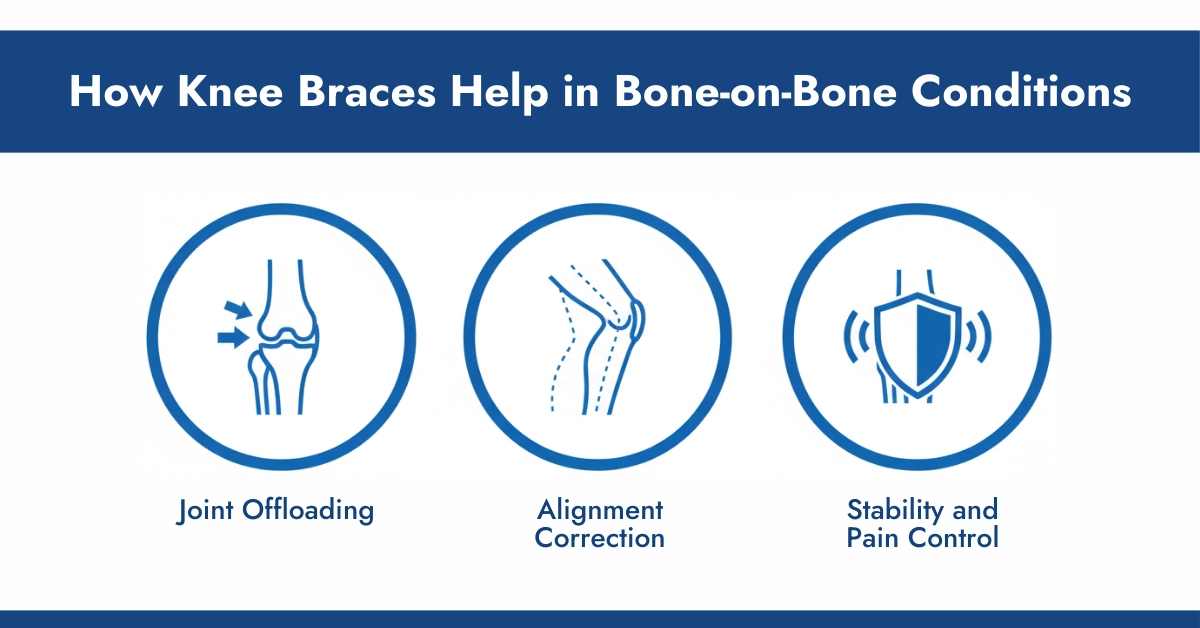
How Knee Braces Help in Bone-on-Bone Conditions
- Joint Offloading: An offloader brace shifts your body weight away from the damaged compartment. Less pressure on bone-on-bone areas means less pain.
- Alignment Correction: Many OA patients develop a bow-legged or knock-kneed posture over time. A brace for advanced osteoarthritis knee corrects this alignment. Proper alignment reduces uneven wear on the joint.
- Stability and Pain Control: Weak or unstable knees cause the surrounding muscles to overwork. A hinged or unloader brace stabilizes the joint. This reduces muscle fatigue and controls pain during movement.
Tips:
Exercise, walking, swimming, managing your weight, and strength training can help to manage osteoarthritis knee pain.
Can a Knee Brace Delay Knee Replacement Surgery?
Yes, in many cases, it can. A well-fitted bone-on-bone knee brace, including Aryse Metforce OA, can reduce symptoms long enough to delay surgery by months or even years. It is especially effective when combined with physical therapy, weight management, and anti-inflammatory strategies. But they are not guaranteed a surgical delay strategy and depend on individual response.
However, a brace is not a permanent fix for Grade 4 Osteoarthritis. If pain becomes constant and daily function is severely impaired, surgery may eventually be necessary. Always consult your orthopaedic specialist.
Types of Knee Braces that Help in Bone-on-Bone Arthritis
Not all braces work the same way. Choosing the right type depends on your OA stage, affected compartment, and activity level.
Unloader (Offloader) Knee Braces
This is the best brace for knee osteoarthritis bone on bone in most cases. An unloader brace has a three-point leverage system. It physically shifts the load away from the damaged side. It works best for people with medial (inner) compartment arthritis or lateral (outer) pain, where only part of the knee is affected.
Hinged Knee Braces
A hinged brace provides strong structural support. It controls side-to-side movement and reduces joint instability. The Aryse Hinged ROM Knee Brace is a solid option for daily use. It is adjustable, durable, and designed for people who need reliable support during walking and light activity. People with severe knee arthritis who need additional stability during walking or daily activities.
Custom Knee Braces
Custom braces are made from a mold of your specific knee. They offer the most precise fit and the highest level of offloading. These are recommended for braces for end-stage knee OA (Grade 4) or when standard braces are not providing enough relief. Custom braces are more expensive but may be covered by insurance in many cases.
Compression Sleeves
Compression sleeves are the most basic option. They improve circulation and reduce mild swelling. The Aryse PureSpeed Knee Brace is a lightweight sleeve option suitable for active users with early-stage OA. However, for true bone-on-bone conditions, a sleeve alone is not enough. It can be used alongside a hinged or unloader brace for added comfort.
How to Choose the Right Bone-on-Bone Knee Brace
Here are the key factors to look at before buying:
- OA Stage: Grade 3 users may do well with hinged braces. Grade 4 users often need unloader or custom braces.
- Affected Compartment: Medial (inner) OA needs a valgus unloader. Lateral (outer) OA needs a varus unloader. Full-knee OA may need custom support.
- Activity Level: High-activity users need rigid hinged support. Low-activity or sedentary users may prefer a softer unloader.
- Fit and Sizing: A poorly fitted brace is useless. Measure the circumference of your thigh (10 cm above the knee) and calf (10 cm below). Also measure across the kneecap. Use these three measurements together to find the right size.
- Material: Look for breathable, moisture-wicking materials. Hard-shell braces provide more support. Fabric braces are more comfortable for long wear.
Common Signs That Should Be Monitored
Many users keep wearing a brace that is simply wrong for them. Watch for these warning signs:
- Pain not improving after consistent use
- Brace keeps slipping during activity
- Skin redness, numbness, or tingling
- Increased swelling after wearing it
- Pain that spreads to the hip or back
If any of these apply, your brace may be the wrong type or size. Consult a physician or orthotist before continuing.
Note:
People managing diabetes should pay close attention here. Diabetic individuals have a significantly higher risk of developing osteoarthritis due to chronic inflammation and metabolic changes. Managing blood sugar levels consistently, using tools like continuous glucose monitors like Dexcom G7 15-day, plays an important role in slowing joint deterioration over time.
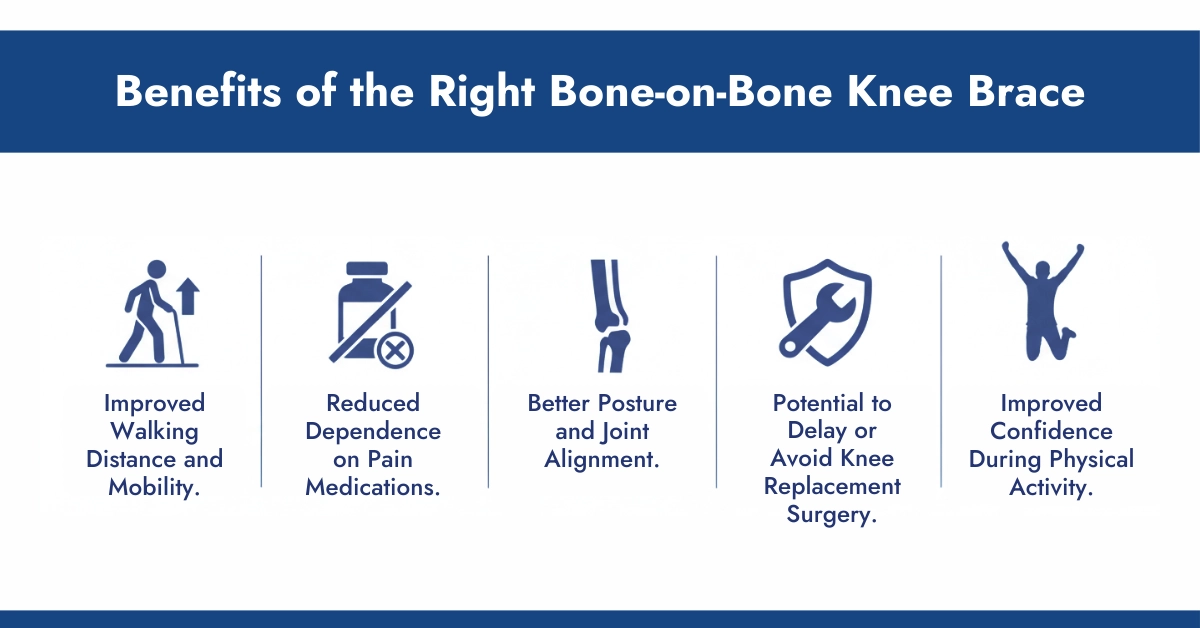
Key Benefits of the Right Bone-on-Bone Knee Brace
Wearing the correct knee support for worn cartilage brings multiple benefits:
- Improved Walking Distance and Mobility.
- Reduced Dependence on Pain Medications.
- Better Posture and Joint Alignment.
- Potential to Delay or Avoid Knee Replacement Surgery.
- Improved Confidence During Physical Activity.
Conclusion
Living with bone-on-bone knee arthritis does not have to mean giving up your mobility or rushing into surgery. The right best knee brace for bone-on-bone arthritis, whether an unloader, hinged, or custom brace, can genuinely change your daily life. The key is choosing based on your OA grade, affected compartment, and activity needs.
At CGM Monitors, we supply quality medical equipment, including trusted knee braces designed to support your daily comfort. Our team is here to help you find the right fit, including insurance-covered options for eligible patients. For more updates and product guidance, visit us on Facebook, Instagram and LinkedIn.
Disclaimer:
This is informational only, not medical advice. Knee braces manage bone-on-bone OA symptoms but don’t cure it. Consult an orthopedist before use for proper fit, use, and type. CGM Monitors supplies quality braces but cannot diagnose conditions or guarantee outcomes. Stop if pain worsens. Images are AI-generated for illustration only.
Frequently Asked Questions
What is the best knee brace for bone-on-bone arthritis?
The best option for most moderate to severe bone-on-bone arthritis is an unloader (offloader) knee brace. These braces are designed to redistribute weight away from the damaged part of the knee and have been shown in clinical studies to improve pain and function compared with placebo braces.
When should I wear a knee brace for bone-on-bone pain?
Wear your brace during activities that cause pain or discomfort, such as walking, climbing stairs, or standing for long periods. Removing it when resting can help prevent stiffness and reduce unnecessary pressure. Proper use maximizes benefit and comfort.
How does an unloader knee brace work for bone-on-bone knees?
Unloader braces apply an external corrective force that reduces the knee’s adduction moment (the inward load that increases stress on the affected compartment). This shifting of load can decrease pain and improve daily function for many users.
Which knee brace is right for medial compartment bone-on-bone arthritis?
For pain primarily on the inner (medial) side of the knee, a valgus unloader brace is often recommended. These braces reduce stress on the affected compartment by shifting the load to the healthier side of the joint, which can ease pain and improve movement.
How Long Should You Wear a Knee Brace Each Day?
Here is a simple, practical guide:
- During activity: Always wear it during walking, standing, or exercise
- At rest: Remove it when sitting for long periods
- At night: Do not wear a rigid brace while sleeping
- Starting out: Begin with 2-4 hours daily
Most users see noticeable improvement within 4-6 weeks of consistent daily use.
Can knee braces cause discomfort or side effects?
Yes, especially if the brace is poorly fitted. Possible issues include skin irritation, pressure sores, rubbing, or a feeling of instability. Working with a healthcare professional to ensure proper sizing and adjustment can reduce these risks.





Write a comment
Your email address will not be published. All fields are required