

Table of content
- First Things First: Can Insulin Really Trigger a Heart Attack?
- How Insulin Actually Works (Quick Refresher)
- Wait… Can Insulin Overdose Really Cause a Heart Attack?
- Signs You’ve Had Too Much Insulin
- Insulin Overdose Symptoms (Some Can Be Serious)
- What Causes Insulin Overdose Anyway?
- What If a Non-Diabetic Uses Insulin?
- Pro Tips to Keep Insulin Doses Safe
- What To Do if You Think You Overdosed the insulin
- How Much Insulin = Too Much?
- Real People, Real Concerns
- Final Thought:
Insulin’s a lifesaver. Literally. But—too much of a good thing? Not always great. If you’re managing diabetes, you probably know insulin helps keep blood sugar in check.
But here are the highlights of an insulin overdose. Can insulin overdose cause a heart attack? (yep, it’s a thing), and how to stay safe. Let’s discuss.
First Things First: Can Insulin Really Trigger a Heart Attack?
So here’s the close picture…
Too much insulin = hypoglycemia (aka super low blood sugar).
Now that alone might not directly cause a heart attack. But… a report shared by PubMed suggests, if you already have heart problems, low blood sugar could push your body into panic mode. Your heart races, stress levels spike — and that combo could lead to a cardiac event. And yes, although not exactly, a cardiac event caused due to excess insulin may be associated with insulin overdose death.
Scary? Yeah.
Common? Not really — but still something to take seriously.
How Insulin Actually Works (Quick Refresher)
- Insulin’s job = helping sugar move from your blood into your cells.
- No insulin = sugar stays in the blood = Hyperglycemia (high blood sugar) = not good.
- Fatal dose of insulin = sugar disappears too fast = Hypoglycemia (low blood sugar) = also not good.
Wait… Can Insulin Overdose Really Cause a Heart Attack?
Technically? No. But hypoglycemia can trigger heart issues in folks already dealing with:
- Heart disease
- High blood pressure
- Arrhythmias (weird heartbeats)
So, if your ticker isn’t 100% — yeah, insulin overdose could be risky.
Signs You’ve Had Too Much Insulin
Watch out for these signs of too much insulin:
- Shaky hands
- Sweating like crazy
- Lightheadedness
- Mood swings or random irritability
- Fast heartbeat
- Confusion (where am I? what day is it?)
If this sounds like you, stop. Check your blood sugar. Eat something or take this Medical News guide for further information.
Insulin Overdose Symptoms (Some Can Be Serious)
Things can get intense, real quick:
- Total fatigue
- Blurred vision
- Cold, sweaty skin
- Headaches
- Confused speech
- Seizures (yikes)
- Or even passing out
If you hit this level — don’t wait. Call 911 or get help ASAP.
What Causes Insulin Overdose Anyway?
Some common slip-ups:
- Injecting too much by accident
- Skipping a meal after taking insulin
- Injecting into a spot where it absorbs too fast (like the belly)
- Messing up timing (timing matters!)
Sometimes it’s human error. Sometimes it’s just… life.
What If a Non-Diabetic Uses Insulin?
That’s a dangerous move.
Their body isn’t used to insulin — even a small amount can tank their blood sugar fast.
If they already have heart issues? Boom — it could get real bad, real quick.
Moral of the story: don’t play around with insulin unless you actually need it.
Pro Tips to Keep Insulin Doses Safe
Let’s keep you out of the danger zone:
- Count your carbs: Match your insulin to what you eat.
- Weigh it out: Some doses are based on your weight. Ask your doctor.
- Use a CGM: Continuous glucose monitors (CGMs) like the Dexcom G6 Sensors give you real-time blood sugar tracking = less guesswork. The best part is that its compatible with latest automatic insulin delivery (AID) systems such as OmniPod 5 (an AID system for both type 1 and type 2 diabetic people).
- Before workouts: Adjust your dose — exercise can drop sugar levels fast.
Stay sharp. Mistakes happen, but prevention is key.
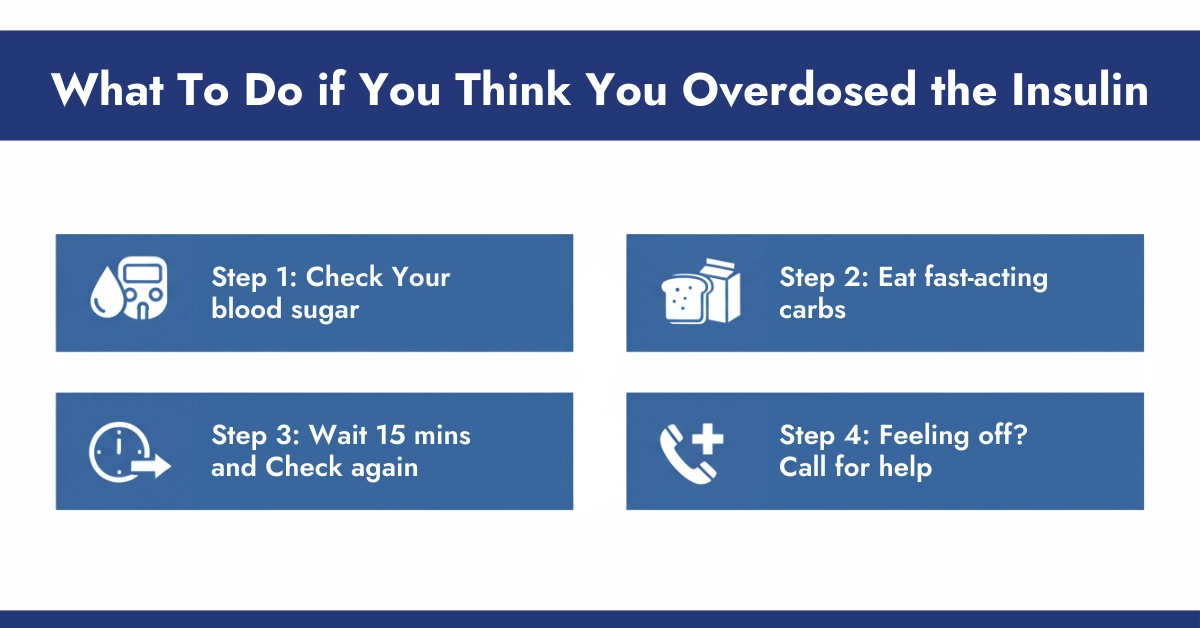
What To Do if You Think You Overdosed the insulin
- Step 1: Check your blood sugar
- Step 2: Eat fast-acting carbs — juice, soda, glucose tabs
- Step 3: Wait 15 mins and check again
- Step 4: Still feeling off? Call for help
Insulin overdose management is a bit difficult, but can save you from severe incidents. Here we have included some of it in the following sheet;
| Action | What To Do |
| Check blood sugar | See how low it is |
| Eat fast-acting carbs | Juice, candy, or glucose tabs |
| Recheck in 15 mins | Blood sugar still low? Eat again |
| Call emergency if needed | Seizures, fainting, or no improvement? |
How Much Insulin = Too Much?
It depends on numerous factors…
There are different types of insulin, i.e., Rapid acting, Regular, Intermediate acting, Long acting, and Ultra long acting insulin. Each of these types has different peak and lasting durations. And depending on a patient’s condition, a specific insulin dose may be too much. For instance, in most states of the USA, U-100 is most commonly used dose, whereas U-500 is available for patients who have extreme insulin resistance, or in other words, say who experience extremely high sugar levels (hyperglycemia).
Always stick to your prescribed dose.
If you’re unsure, don’t guess — ask your doc.
Real People, Real Concerns
“I didn’t eat after injecting. Thought I’d be fine. Ended up with chest pain and a panic attack. Never skipping meals again!” — Type 1 Reddit user
“My sugar dropped to 35 and my heart was beating out of my chest. Scariest moment ever.” — Cgm Monitors’ user Ask.
People are out here living this. Don’t wait until it happens to you.
Final Thought:
Insulin saves lives.
- But misuse? It can get dangerous fast.
- Follow your dose
- Eat consistently
- Monitor your levels
- Keep snacks handy
- And when in doubt… call your provider.
Stay safe. Stay balanced. And treat that insulin with the respect it deserves.
Disclaimer: This blog is only for informational purposes and does not substitute your doctor’s advice.





Write a comment
Your email address will not be published. All fields are required