
Table of content
- Introduction
- Does Your Libre Sensor Hurt?
- What It Feels Like During Application
- Pain Comparison Between Libre Sensors in 2026
- Arm Pain After Application: What’s Really Going On
- Does Removing the Sensor Hurt?
- Why Does My Libre Sensor Hurt? – Possible Reasons
- Physical Issues Users Commonly Mention
- How Libre Users Reduce Pain and Discomfort
- Conclusion
Introduction
Many people ask on the internet, ‘does freestyle libre hurt?’ It means numerous people are curious to know the worse impact of Freestyle Libre sensors on their bodies. In this article, we have resolved nearly all the queries about this device being painful or not.
In this article, you will learn what the Freestyle Libre actually feels like when it is applied, worn, and removed, based on real user experiences. You will understand why some users experience discomfort, what causes it, and when it is considered normal. You will also discover simple and practical ways to reduce pain and improve overall comfort while using a Freestyle Libre sensor.
Key Takeaways
- Freestyle Libre usually causes only a brief pinch, not real pain.
- Most users find it less painful than finger-stick tests.
- Any discomfort is typically mild and temporary.
- Proper placement helps reduce pain and irritation.
Does Your Libre Sensor Hurt?
For most users, Freestyle Libre does not hurt beyond a brief sensation during application. Many users describe it as a quick pinch or pressure that lasts only a second. That said, some people do experience soreness or arm discomfort, especially in the first few days or if the sensor placement isn’t ideal. This doesn’t mean something is wrong—but it does mean there are things you should know.
What It Feels Like During Application
The Freestyle Libre applicator looks intimidating, but the needle is:
- Very thin
- Only used to insert the filament
- Removed immediately
Users often describe the sensation as:
- A fast snap, like a rubber band
- A brief pressure
- A light sting that disappears instantly
People who apply the sensor correctly — relaxed arm, clean skin, steady press — often report no pain at all. Anxiety tends to make the moment feel worse than it actually is.
Pain Comparison Between Libre Sensors in 2026
When it comes to sensor comfort, many users want to know how the older Freestyle Libre models compare to the newer versions. While Abbott has phased out Freestyle Libre 2 and Libre 3 in late 2025, they are still used by some patients due to the bundle of buying. Understanding their differences helps new users make informed choices and sets realistic expectations.
Freestyle Libre 2 (Discontinued in late 2025)
Freestyle Libre 2 was widely used for many years and is considered a legacy sensor. Applying it may cause a brief prick or pressure at insertion, but most users find the sensation mild and short-lived.
- The adhesive is firm, which keeps the sensor in place, but may occasionally cause skin irritation or redness, usually resolving within a few days.
- Proper placement on the back of the arm or flat areas helps minimize discomfort.
- Removal feels like taking off a strong adhesive bandage, with mild temporary stinging for sensitive skin.
Overall, Libre 2 was comfortable for most users, and any pain experienced was usually related to placement or skin sensitivity, not the sensor itself.
Freestyle Libre 3 (Discontinued in 2026)
Freestyle Libre 3 was the first smaller, thinner, real-time CGM from Abbott. It improved comfort for many users compared to Libre 2, though placement still mattered more due to its compact size.
- Users often report barely noticing the sensor when applied correctly.
- Updated adhesive reduced the frequency of skin irritation and allergic reactions compared to Libre 2.
- Discomfort, if present, was usually minor and temporary, often caused by muscle contact or tight clothing.
Even though Libre 3 is discontinued, many patients who used it found it easier to wear than older sensors.
Freestyle Libre 3 Plus (Current Model in 2026)
The Freestyle Libre 3 Plus is the newest generation and is designed with comfort and usability in mind:
- Smaller and lighter than previous models, making it almost unnoticeable for most users.
- Improved adhesive minimizes skin irritation, and sensor placement is more forgiving.
- Suitable for younger users (age 2+ in some markets) and integrates with compatible apps and devices for real-time glucose tracking.
- Removal is gentle, with minimal discomfort compared to earlier models.
For patients switching from older sensors, Libre 3 Plus offers the most comfortable, user-friendly experience currently available.
Arm Pain After Application: What’s Really Going On
Some users notice arm soreness hours or days after applying the sensor. This usually isn’t from the needle — it’s from placement and movement.
Common reasons include:
- Sensor placed too close to muscle
- Pressure while sleeping
- Repeated arm movement rubbing the adhesive
- Skin sensitivity
The pain is typically dull or sore, not sharp. If sharp pain persists, it’s often a sign the sensor is pressing against muscle tissue or was applied at an angle.
When Arm Pain Is Not Normal
You should contact a healthcare professional if:
- Pain becomes sharp or severe
- Redness or swelling increases
- There is warmth, discharge, or signs of infection
- Pain does not improve after a few days
Does Removing the Sensor Hurt?
Removing a Libre sensor should not be painful, but the adhesive can pull on the skin.
To make removal easier:
- Use warm water or adhesive remover
- Peel slowly, not straight up
- Support the skin with your other hand
Skin irritation after removal is more common than pain during removal.
Why Does My Libre Sensor Hurt? – Possible Reasons
Here are a few possible reasons that may negatively affect you if negligence occurs during the application process.
Inserted Too Deep or at the Wrong Angle – penetrate deeper than intended or enter at an angle that causes discomfort.
Placed on a Muscle Instead of Fatty Tissue – Applying the sensor too close to the muscle can cause soreness, especially when you move your arm.
Hitting a Nerve-Rich Area – Although uncommon, the sensor may touch an area with more nerve endings, causing pain or tingling.
Bruising Under the Skin – The filament may hit a small blood vessel during insertion, leading to mild bruising and tenderness.
Allergic Reaction to Adhesive – Redness, swelling, or rash around the sensor area may indicate an adhesive allergy, which can be painful.
Sensor Adhesive Causing Skin Irritation – Some users react to the adhesive, experiencing itching, burning, or irritation around the sensor site.
Wearing the Sensor Longer Than Recommended – Using the sensor beyond its approved wear time can irritate the skin or cause discomfort.
Physical Issues Users Commonly Mention
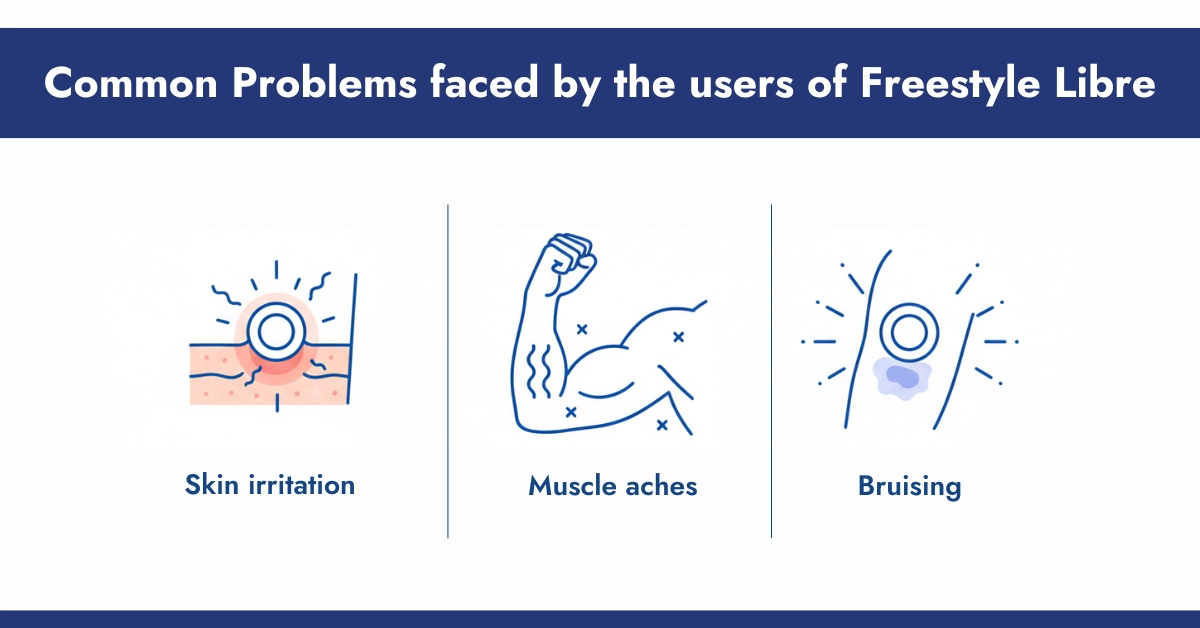
Here is the list of Freestyle Libre users’ most common physical problems.
- Skin irritation
- Muscle aches
- Bruising
Skin irritation
When the sensor is applied, some people feel irritation. It can be due to multiple reasons. One of the most common reasons is that the person is allergic to the adhesive material of the sensor. Moreover, if the user does not clean the surface before applying the sensor, it irritates them. It is because the adhesive material interacts with the dirt, making you uncomfortable.
Muscle aches
Many people complain of having muscle aches after applying the sensor. However, the device is restricted to insert into the skin. However, the pain refers deep to muscles. One of the common reasons for this problem is the tightening of the muscles when the sensor is inserted.
Bruising
Bruising is also a common problem faced by Freestyle Libre users. It happens primarily due to pressing too hard while installing the sensor. The pin in the sensor may pinch a vessel underneath the skin, forming a bruise.
How Libre Users Reduce Pain and Discomfort
The Freestyle Libre 2 users mostly look for competent pain, irritation, and bruising solutions. They can adopt the following tactics to avoid these problems.
Clean the surface
Before applying the sensor to the skin, they must clean the surface appropriately. Washing is necessary. You can use any detergent for this purpose. After this, you need to dry the skin well. It sustains the stickiness of the adhesive material for a long time. Also, remove the hair at the application site, as they reduce the sticking life of the sensor.
Use allergy-free patches
Considering people’s allergies and skin irritation problems, some manufacturers have made allergy-free patches. Users have to apply these patches on the skin. Above them, they can install the sensor quickly. In this way, they avoid skin irritation problems.
Important Notice: As of the September 2025 latest updates of Abbott. FreeStyle Libre 2 and 3 are permnently discontinued. Choose wither 15 days Libre 2 Plus or libre 3 Plus for managing diabetes.
Conclusion
For the majority of users, Freestyle Libre is not painful. When discomfort does occur, it’s usually temporary and related to placement, pressure, or skin sensitivity—not a problem with the device itself.
With proper application and experience, many people reach a point where they barely notice the sensor at all.
If you’re new to CGMs or experiencing discomfort, remember:
- Your experience is valid
- Pain is not something you should ignore
- Support and guidance can make a big difference
Freestyle Libre is meant to make glucose monitoring easier—not harder.
Frequently Asked Question
How much pain is typically associated with applying a Freestyle Libre sensor?
Most people feel no pain or just a brief pinch/pressure during insertion. Studies and users report it’s virtually painless for the vast majority, far less than finger pricks.[/vc_toggle
How can I minimize pain when applying my Freestyle Libre sensor?
Choose a fatty spot on the back of your upper arm (avoid muscle), clean and dry skin well, and press the applicator firmly and quickly. If sensitive, try a topical numbing cream (consult your doctor) and relax your arm during application.
How long is it normal for a Freestyle Libre sensor to feel uncomfortable?
Any mild sensation usually fades within minutes to a few hours after insertion. Most users feel nothing ongoing; persistent discomfort beyond a day isn’t typical.
What does the Freestyle Libre sensor application feel like?
It feels like a quick press or mild pinch when the applicator clicks—often nothing at all. The tiny filament goes in fast with the automated applicator, and any feeling disappears almost immediately.
What are the best techniques for a painless Freestyle Libre sensor insertion?
Apply to fatty upper arm tissue (not over muscle), hold steady, press applicator firmly straight down, and avoid tensing. Prep skin clean and dry, relax the arm fully, and follow instructions exactly for smooth, quick insertion.
What causes prolonged pain from a Freestyle Libre sensor after it's applied?
It can stem from hitting a nerve, placing too close to muscle, filament movement, or adhesive irritation. Rarely, minor bleeding or poor placement causes ongoing ache—most resolve quickly or with a site change.
Why might a Freestyle Libre sensor application hurt more for some people?
Individual factors like low pain tolerance, thin skin, nerve hit, or muscle placement increase sensitivity. Adhesive reactions or improper technique (e.g., tensing arm) can make it feel worse than average.
Why does my Freestyle Libre sensor sometimes hurt after application?
It may be from filament irritating a nerve, muscle proximity, minor swelling, or arm movement rubbing it. Most post-insertion aches settle fast; ongoing pain often signals a bad placement spot.
When should I seek medical advice if my Freestyle Libre sensor application is consistently painful?
If pain persists across multiple sensors, worsens, or includes swelling, redness, or infection signs. Consult your doctor to rule out skin reactions, allergies, or other issues—don’t ignore recurring problems.
When should I remove a Freestyle Libre sensor if it's causing persistent pain?
Remove it if discomfort lasts more than a few hours (or per Abbott: beyond 1 hour in some guidance) and interferes with daily life. Contact Abbott for a replacement—better to swap early than endure; try a new fatty site next time.
Freestyle Libre 3 Plus hurts my arm — why?
If the Freestyle Libre 3 Plus hurts your arm, possible reasons include:
- Inserting too close to muscle
- Pressing the applicator too firmly
- Allergic reaction to the adhesive
- Sensitive skin or local inflammation
Switching to the opposite arm or using an adhesive barrier may help.
Does the Libre sensor pierce the skin?
Yes, the thin filament goes just beneath the skin’s surface to read glucose levels—but it’s flexible and not painful for most people.
Is it normal for FreeStyle Libre to bruise?
Yes, mild bruising can happen if small blood vessels are hit during insertion. It’s harmless and fades within a few days.
How to remove a FreeStyle Libre sensor without pain?
Gently peel the edges and use oil or adhesive remover to loosen the patch. Slow removal reduces skin irritation.
Is the Freestyle Libre painful?
Most users do not find the Freestyle Libre painful. The sensor uses a very thin, flexible filament, not a needle, so the insertion usually feels like a quick pinch or mild pressure. However, some people with sensitive skin may experience temporary discomfort.
Does it hurt to put on Freestyle Libre 3?
Inserting the Freestyle Libre 3 usually doesn’t hurt. You might feel:
- A quick pinch
- Slight pressure for 1 second
- No pain after insertion
If it hurts more than expected, your placement may be too close to muscle or a nerve-ending area. Try applying it slightly higher or lower on the back of the arm.
Libre 3 hurts my arm — is this normal?
If the Libre 3 hurts your arm, it can happen due to:
- Incorrect placement
- Pressing too hard during insertion
- Low body fat in the application area
- Skin irritation or adhesive sensitivity
Mild soreness for the first few hours is normal, but continuous pain may indicate a poor placement or skin reaction
What are the benefits of using Freestyle Libre 3?
Freestyle Libre 3 provides real-time glucose data, eliminates finger pricks, and has a compact, sleek design with updated adhesive material for user comfort.
Does Freestyle Libre hurt?
Some users may feel pricking pain, skin irritation, and allergies, which lasts a few days and is insignificant.
What are the common physical problems faced by Freestyle Libre users?
The most common physical problems faced by Freestyle Libre users are skin irritation, muscle aches, and bruising.
What are the competent solutions to avoid the physical problems caused by Freestyle Libre?
Clean skin, use allergy-free patches, and upgrade to Freestyle Libre 2 and 3 Plus to avoid physical problems.
Top Selling Products
Featured Products




Write a comment
Your email address will not be published. All fields are required