

G6/G7 Vs FreeStyle vs Medtronic CGM Accuracy Comparison 2026
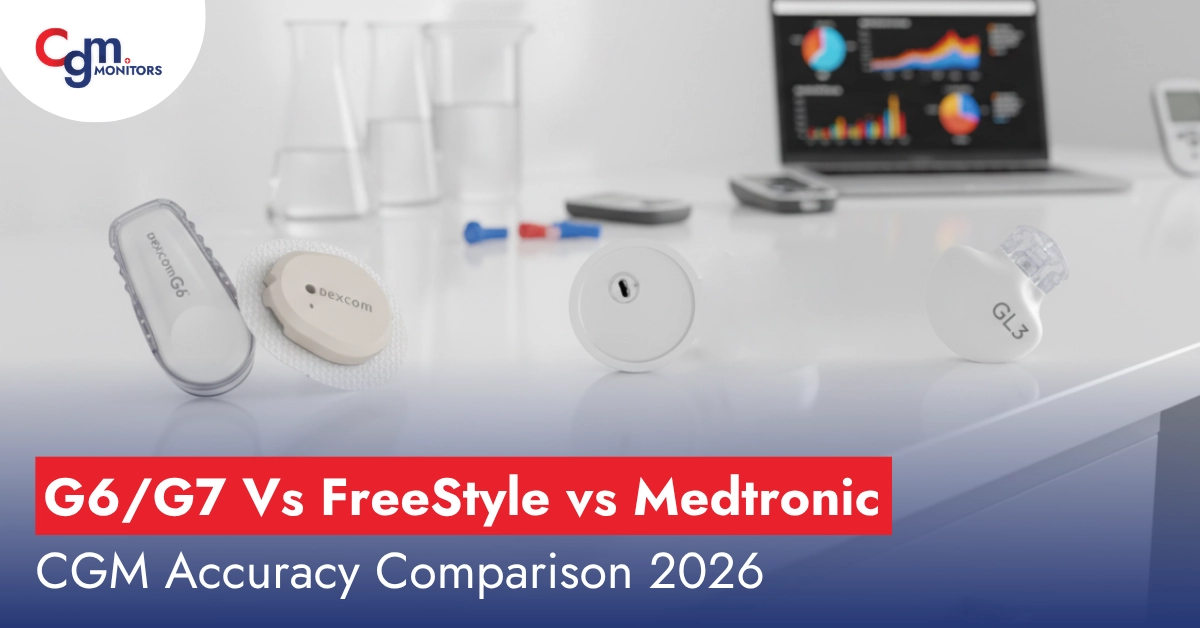
Table of content
- What Is MARD & Why It Matters To You
- Dexcom Accuracy in 2026: G6, G7, and G7 15-Day
- Most insurance plans that cover G6 will cover G7 at parity.
- FreeStyle Libre Accuracy: Libre 2 vs Libre 3 vs Libre 3 Plus
- Medtronic Accuracy: Guardian 4 vs Simplera Sync
- Eversense 365: A Different Category
- 2026 CGM Accuracy Comparison Table
- The Hidden Accuracy Problems Nobody Warns You About
- Which CGM Is Actually Better for You in 2026?
- Conclusion:
- Frequently Asked Questions
You check your CGM. It says 61 mg/dL. You feel completely fine. You eat 20g of carbs just in case, and an hour later, you’re at 190.
Sound familiar? That’s not a device failure. That’s a CGM accuracy gap that nobody prepared you for.
Inaccurate readings cause real harm, over-corrected insulin doses, missed overnight lows, and false alarms that make you ignore the real ones. This CGM accuracy comparison covers every major sensor in 2026 with the correct clinical data, the latest updates, and one clear answer: which device is actually better for your situation.
What Is MARD & Why It Matters To You
MARD (Mean Absolute Relative Difference) is the standard measure of CGM accuracy. It’s the average percentage gap between your sensor reading and a true lab blood glucose value. Lower is better.
- Below 9%: Clinically excellent, safe for insulin dosing.
- 9-11%: Reliable for daily management.
- Above 12%: Acceptable but less reliable during rapid changes.
MARD is an average. A sensor scoring 9% overall can still miss badly during a fast overnight low. Always look at how a sensor performs at the extremes, not just the headline number.
Dexcom Accuracy in 2026: G6, G7, and G7 15-Day
Dexcom G6 (10 days):
- MARD: 9.0% vs lab reference.
- Factory calibrated, no fingerstick required.
- Real-time alerts, compatible with Tandem t:slim X2 and Omnipod 5.
Important: Dexcom officially stopped manufacturing the G6 on July 1, 2026. Remaining stock may still be available through pharmacies and DME distributors for a limited time, but availability is not guaranteed. Dexcom is urging all G6 users to upgrade to G7 or G7 15-Day now.
Most insurance plans that cover G6 will cover G7 at parity.
Dexcom G7 (10-day)
- MARD: 8.2%, clinically most accurate CGM in published 2026 data.
- 30-minute warm-up shortest of any CGM available today.
- All-in-one design, no separate transmitter.
- FDA-approved from age 2, the strongest pediatric accuracy data available.
- Compatible with Tandem t:slim X2, Omnipod 5, and iLet Bionic Pancreas.
Dexcom G7 15-Day (2026 upgrade)
- MARD: ~8.0%, same clinical accuracy as 10-day with 50% fewer sensor changes.
- Designed for adults 18 years and older.
- Apple Watch direct display, no phone required.
- Tandem t:slim X2 compatibility confirmed for 2026.
- Best choice for adults who want fewer disruptions without sacrificing accuracy
CGM Monitors carries Dexcom G7 sensors, starter kits, receivers, and G7 adhesive overlay patches, with insurance billing and free nationwide delivery.
FreeStyle Libre Accuracy: Libre 2 vs Libre 3 vs Libre 3 Plus
FreeStyle Libre 2 (14 days)
- MARD: 9.3%.
- Requires manual scanning, no automatic real-time readings.
No scan means no data. Users can be low for 20+ minutes before realizing it. In 2026, this is a safety limitation you don’t need to accept.
FreeStyle Libre 3
- MARD: 7.9% (lab condition), ~9-11% (real-world comparison).
- Fully automatic real-time readings every minute.
- World’s smallest CGM sensor, size of two stacked pennies.
- Strongest day-1 accuracy of any sensor, stabilizes faster after insertion than Dexcom or Guardian.
- 14-day wear, zero calibration required.
FreeStyle Libre 3 Plus (15-day)
- MARD: 8.2% (lab-based), matches Dexcom G7 in published head-to-head clinical studies.
- 15-day wear with accuracy maintained through the final day
2026 update: Abbott issued a Medical Device Correction for select Libre 3 and Libre 3 Plus sensor batches in late 2025 due to a manufacturing issue.
CGM Monitors stocks FreeStyle Libre 2, Libre 3, and Libre 3 Plus sensors, readers, monthly subscriptions, and adhesive patches with and without cutout.
Medtronic Accuracy: Guardian 4 vs Simplera Sync
Medtronic Guardian 4
- MARD: 8.7%, clinically strong, slightly behind G7 and Libre 3 Plus
- 7-day wear, no fingerstick calibration
The real advantage isn’t raw MARD, it’s deep integration with the MiniMed 780G closed-loop system. Sensor + pump + SmartGuard algorithm working together often outperforms any standalone accuracy number.
Medtronic Simplera Sync (FDA-approved 2025)
- MARD: ~10.5% vs lab reference, highest variability of the major 2026 sensors
- 14 day wear, factory-calibrated.
Genuine strength: Detected 93% of low glucose events in the 2025 Freckmann head-to-head study, outperforming both G7 and Libre 3 for hypoglycemia detection
Known limitation: Reads consistently lower in the mid-to-high range, triggering unnecessary alarms for many users
CGM Monitors carries the Medtronic Simplera Sync and Guardian-compatible sensors for users within the Medtronic pump ecosystem.
Eversense 365: A Different Category
Eversense 365
- MARD: 8.5%.
- Wear time: 365 days.
- Calibration: Twice daily.
This isn’t just another CGM, it’s a different model entirely:
- One insertion per year.
- No weekly sensor changes.
Trade-off: Requires calibration and a minor procedure.
2026 CGM Accuracy Comparison Table
| Device | MARD | Wear Time | Warm-Up |
| Dexcom G6 | 9.0% | 10 days | 2 hours |
| Dexcom G7 (10-day) | 8.2% | 10 days | 30 min |
| Dexcom G7 (15-day) | ~8.0% | 15.5 days | 30 min |
| FreeStyle Libre 2 | 9.3% | 14 days | 1 hour |
| FreeStyle Libre 2 Plus | ~8.2% | 15 days | 1 hour |
| FreeStyle Libre 3 | ~7.9% | 14 days | 1 hours |
| Libre 3 Plus | 8.2% | 15 days | 1 hours |
| Guardian 4 | ~8.7% | 7 days | 2 hours |
| Simplera Sync | ~10.5% | 14 days | <2 hours |
| Eversense 365 | ~8.5% | 365 days | 24 hours |
The Hidden Accuracy Problems Nobody Warns You About
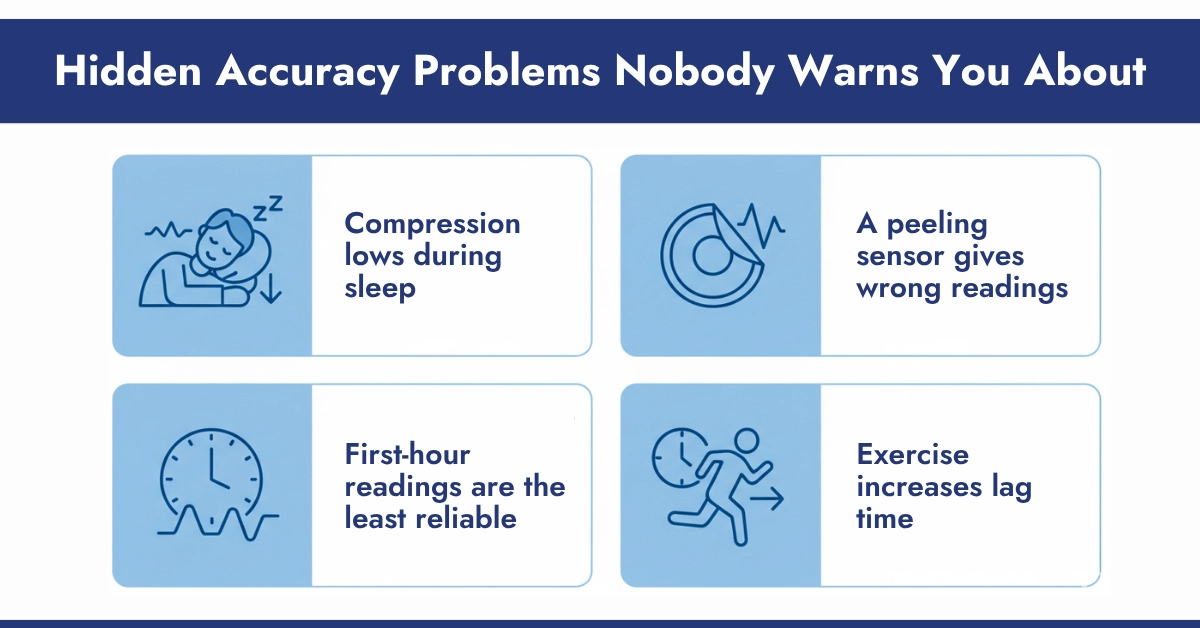
- Compression lows during sleep: Rolling onto your sensor reduces local blood flow and drops the reading artificially. Move your sensor to the back of your upper arm to eliminate most false nighttime alarms.
- A peeling sensor gives wrong readings: When adhesive lifts, the sensor filament shifts under the skin and reads from a different glucose environment. CGM overlay patches are an accuracy tool, not just comfort. CGM Monitors carries patches for every major sensor.
- First-hour readings are least reliable: Every sensor is least accurate right after warm-up. Libre 3 stabilizes fastest; Guardian 4 takes the longest.
- Exercise increases lag time: Interstitial fluid lags blood glucose by 5-15 minutes. During intense activity, that gap widens. Always fingerstick-verify before dosing insulin mid-workout.
Which CGM Is Actually Better for You in 2026?
- On insulin, fear overnight lows → Dexcom G7 (10-day). Fastest warm-up, tightest lag during rapid drops, best real-time alert performance.
- Want fewer sensor changes with the same accuracy → Dexcom G7 15-Day. Adults 18+ get 15.5 days of G7-level accuracy with Apple Watch support. Biggest upgrade of 2026.
- Want the longest wear and near-identical accuracy to G7 → FreeStyle Libre 3 Plus. 15-day wear, smallest sensor, strongest day-1 stability. Ideal for T2D and anyone wanting simplicity.
- Using a MiniMed insulin pump → Guardian 4. The closed-loop system performance matters more than raw MARD. Don’t switch brands just for a marginal accuracy difference.
- Parent of a child with Type 1 → Dexcom G7 (10-day). FDA-cleared from age 2, the only option here.
- Want zero sensor changes all year → Eversense 365. One implant, one warm-up, 365 days of continuous readings. A completely new category, FDA-approved in 2026. Requires twice-daily fingerstick calibrations.
- Still using Dexcom G6 → Upgrade now. Manufacturing ended July 1, 2026. Stock is limited and not guaranteed. Your insurance most likely covers G7 at the same rate.
Conclusion:
CGM Monitors is a leading DME supplier in the USA, carrying genuine Dexcom, Abbott, Medtronic, and Omnipod CGM systems with a 94% customer satisfaction rating on Google. They offer free nationwide delivery, insurance billing, and monthly refills, so you can focus on managing your diabetes instead of managing your supply chain. Follow us on Facebook and Instagram for 2026 CGM updates, coverage tips, and device guides that actually reflect real-world accuracy and user experience.
Disclaimer:
This content is for informational purposes only and is not medical advice. CGM readings can vary and should not replace professional guidance. Always consult your healthcare provider and confirm critical readings before making treatment decisions.
Frequently Asked Questions
Which CGM is most accurate CGM in 2026?
Dexcom G7 and FreeStyle Libre 3 Plus are the most accurate, both achieving MARD values between 7.9-8.5% in clinical studies. For most users, the difference is negligible; insurance coverage and pump compatibility matter more.
Is Dexcom G7 worth upgrading from G6?
Yes. G7 has a tighter MARD (8.2% vs 9-10%), a 30-minute warm-up vs 2 hours for G6, and faster trend response during rapid glucose changes. If your insurance covers it, the upgrade is meaningful.
Why does my CGM read differently from my fingerstick?
CGMs measure glucose in interstitial fluid, not blood. There is a natural 5-15 minute lag, which widens during rapid changes like exercise or post-meal spikes. Trust trends over single numbers, and always fingerstick-verify before insulin dosing if something feels off.
Can CGM patches actually improve accuracy?
Indirectly, yes. A sensor that stays firmly in place reads from a consistent glucose environment throughout its full wear life. A lifted sensor drifts. Properly fitted patches for Dexcom G7, Libre 3, and Omnipod 5 sensors prevent that drift.
Does Medtronic Guardian 4 beat Dexcom G7 in accuracy?
In pure MARD, Dexcom G7 holds a small edge. Guardian 4’s advantage is closed-loop integration with MiniMed pumps; the overall system accuracy, not just sensor accuracy, is what matters for pump users.
What is Eversense 365 and is it worth it?
Eversense 365 is the world’s first one-year implantable CGM, FDA-approved in 2026. One sensor insertion gives 365 days of readings with a single warm-up period. It requires twice-daily fingerstick calibrations. Best suited for people who want the ultimate freedom from sensor changes and are comfortable with a minor in-office procedure.
Is Libre 3 covered by insurance in 2026?
Most commercial plans, Medicare, and qualifying Medicaid plans cover Libre 3. CGM Monitors handles eligibility checks, prior authorization, and monthly refills, you just need your insurance card and doctor’s information.


Write a comment
Your email address will not be published. All fields are required