
Table of content
- What Is a Knee Brace and What It Matters?
- Types of Knee Braces: Know Before You Buy
- 6 Best Knee Braces: The Top Pick
- How Knee Braces Reduce Pain (Simple Science)
- What Actually Matters When Choosing a Knee Brace
- When Should You Start Wearing a Knee Brace?
- How To Wear a Knee Brace Correctly?
- Conclusion:
- Frequently Asked Question
Your knee has been hurting for weeks. You ordered a brace online, wore it twice, and it’s sitting in a drawer now. Sound familiar?
Most people don’t fail because they didn’t try. They fail because they picked the wrong knee brace for the wrong problem. A compression sleeve won’t stabilize a ligament injury. A rigid hinged brace is overkill for mild arthritis. And a brace that slips after 10 minutes isn’t helping anyone. That’s why the real solution is not just buying a brace, it’s matching the right recovery system to your actual knee condition like material, design and support level.
This guide helps you match the right support to your actual condition, so you stop guessing and start recovering.
What Is a Knee Brace and What It Matters?
A knee brace is a structured support device worn around the knee joint. It stabilizes the joint, limits harmful movement, and distributes pressure away from damaged or inflamed tissue.
A brace doesn’t heal your knee; it creates the conditions for healing. It prevents the small, repeated movements that cause re-injury while your body repairs itself.
A good brace helps by:
- Reduces pain by offloading stress from sensitive areas.
- Improves function so you can walk, climb stairs, or stay active.
- Prevents further damage by limiting extreme or unstable motion.
Without the right fit and the right type, none of these benefits happen consistently.
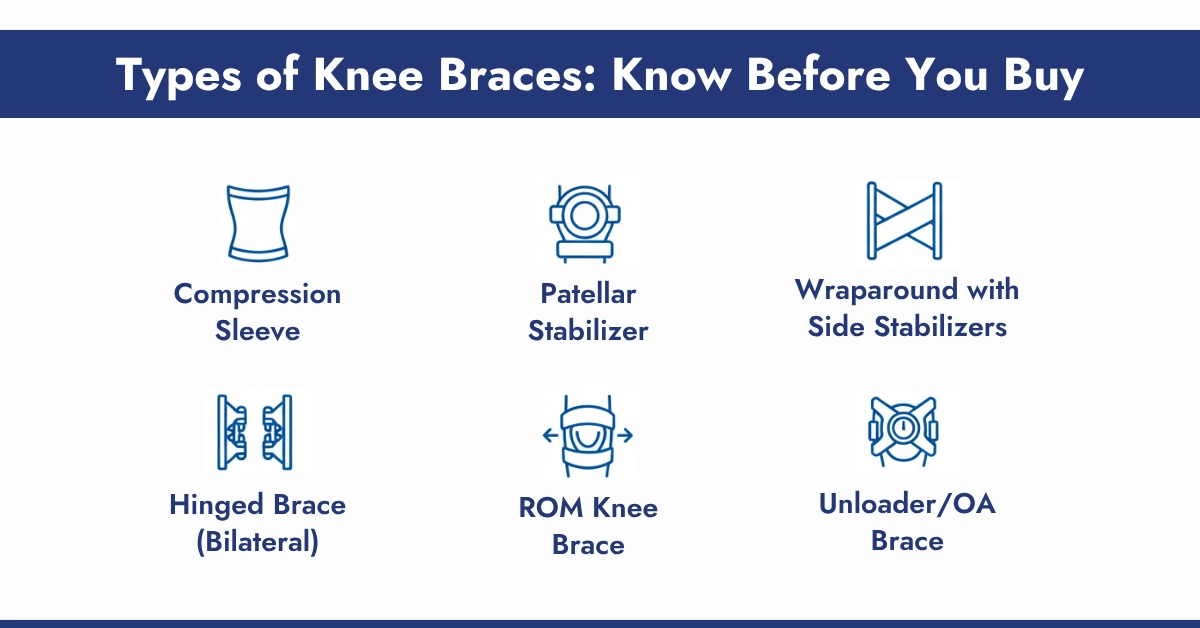
Types of Knee Braces: Know Before You Buy
Choosing the wrong type is the biggest reason braces fail. Here is the honest breakdown.
- Compression Sleeve: The most popular and most misused type. Provides warmth, reduces swelling, and improves proprioception. Does not mechanically stabilize the joint. Suitable for mild pain, general activity support, and arthritis flare management. It is lightweight and breathable.
- Patellar Stabilizer: Designed specifically for kneecap issues and limited ligament support. Uses a buttress system to correct patellar tracking. Best for runner’s knee, chondromalacia, and patellofemoral pain syndrome.
- Wraparound with Side Stabilizers: Adds spring or metal stabilizers to compression. Provides moderate medial and lateral control. Best for mild MCL sprains and general instability during daily activity.
- Hinged Brace (Bilateral): Aluminum hinges on both sides resist valgus and varus forces. The standard recommendation for ACL, MCL, and meniscus injuries. Cannot substitute a ROM brace post-surgery.
- ROM Knee Brace: The most clinically advanced consumer option. An adjustable hinge lets clinicians lock the joint to specific degrees, then open progressively as recovery advances. The gold standard for post-surgical rehabilitation.
- Unloader/OA Brace: Redistributes load away from the damaged compartment of an arthritic knee. Specifically designed for osteoarthritis, where cartilage loss is asymmetric.
Among all types, the ROM system is the most advanced because it actively guides recovery instead of only supporting it.
6 Best Knee Braces: The Top Pick
These are the most trusted global brands used in sports medicine and rehabilitation.
1. Aryse Hinged ROM Knee Brace (Best Overall)
Aryse is the most advanced range-of-motion (ROM) rehabilitation system.
- Example: Aryse Hinged ROM Knee Brace.
- Example: Aryse Metforce OA Brace.
Strength:
- Adjustable motion control.
- Post-surgery rehab system.
- OA + ligament recovery support.
- Lightweight medical frame design.
This is the core recovery solution for structured healing, especially when movement must be controlled, not restricted or left unsupported, offered by CGM monitors.
2. DonJoy (Best for Ligament Protection)
DonJoy is widely used in sports medicine clinics.
- Example: DonJoy Defiance ACL Brace.
- Example: DonJoy Armor Knee Brace.
Strength:
- Maximum stability.
- Used for ACL, MCL injuries.
- Recommended by orthopedic specialists.
Best for athletes needing strong external protection.
3. Bauerfeind (Best for Comfort + Arthritis)
German-engineered compression technology.
- Example: GenuTrain Knee Brace.
- Example: GenuTrain S Hinged Brace.
Strength:
- Breathable compression knit
- Excellent for arthritis & daily wear
- Long-term comfort
4. Medi (Best Clinical Rehabilitation Fit)
Medical rehabilitation-focused brand.
- Example: Medi Protect Knee Brace.
- Example: Medi Genumedi Knee Support.
Strength:
- Precise anatomical support.
- Post-surgery recovery focus.
5. Neenca (Best Budget Compression Option)
Popular Amazon-level brand.
- Example: Neenca Professional Knee Brace.
Strength:
- Affordable.
- Gel pad support.
- Good for mild pain.
6. Qinux (Basic Everyday Support)
Entry-level support brand.
- Example: Qinux Knee Compression Brace.
Strength:
- Lightweight.
- Simple daily use.
- Not for serious injuries.
How Knee Braces Reduce Pain (Simple Science)
Knee braces reduce pain through mechanical support and load redistribution.
Key mechanism:
- Reduced joint stress → less inflammation.
- Controlled movement → less tissue irritation.
- Better alignment → improved walking stability.
Different brands act differently:
- Aryse → controlled healing motion system.
- DonJoy → structural ligament protection.
- Bauerfeind → compression-based pain relief.
- Medi → clinical rehabilitation alignment.
- Neenca/Qinux → basic support only.
What Actually Matters When Choosing a Knee Brace
1. Material Determines Longevity
- Knit fabric = comfort but less support.
- Carbon/metal frame = durability but heavier.
2. Hinges Define Medical Grade vs Casual Use
- No hinge → compression only.
- Soft hinge → moderate support.
- ROM hinge → clinical recovery system.
3. Compression Level Affects Recovery Speed
- Low compression → comfort.
- High compression → swelling control.
- Structured support → injury stabilization.
4. Price vs Performance Reality
- Cheap braces fail faster under load.
- Premium braces reduce long-term injury risk.
When Should You Start Wearing a Knee Brace?
Start as soon as pain or instability begins to affect how you move, not after weeks of pushing through it.
Common signs you need support now:
- Your knee gives way or feels loose during walking.
- You avoid stairs because of pain or fear of collapse.
- Swelling returns after activity and takes hours to settle.
- You’ve had a sprain, tear, or fracture in the past and feel vulnerable.
A knee brace is also appropriate before injury for high-risk activities. Athletes in contact sports, people returning from surgery, and individuals with osteoarthritis all benefit from preventive use.
How To Wear a Knee Brace Correctly?
Most people underestimate this step. A poorly applied brace is nearly useless.
Follow these steps every time:
- Position the kneecap in the center cutout or support pad, not above or below
- Align the hinges (on hinged braces) with the natural bend point of your knee
- Fasten bottom straps first, then work upward
- Check compression, firm but not painful; one finger should fit between the brace and skin
- Readjust mid-day as swelling changes, braces loosen naturally with movement
A brace that slides, bunches, or pinches the back of your knee is either the wrong size or incorrectly applied.
Conclusion:
The best knee brace is not the most expensive or popular. It is the one that correctly matches your condition, fits your body at all three measurement points, and that you will wear consistently enough to make a difference.
For structured recovery, Aryse ROM system at CGM Monitors stands as the most advanced solution, especially for post-surgery and controlled rehabilitation needs.
Other brands like DonJoy, Bauerfeind, and Medi serve specific roles, but the real success depends on correct selection, not branding alone.
CGM Monitors offers free shipping across the USA, verified insurance processing, and a support team that handles every step from eligibility to delivery.
Follow CGM Monitors on Facebook and Instagram for product updates, insurance tips, and health management resources.
Disclaimer:
This guide is for educational purposes only. Knee braces support recovery but do not replace medical diagnosis or treatment. Always consult a healthcare professional for serious injuries or persistent pain. Images in this intent are generated from AI or for Illustrative purposes.
Frequently Asked Question
Can I wear a knee brace all day?
Yes, most compression and hinged braces are safe for all-day wear. Remove it if you experience numbness, skin irritation, or increased swelling.
Does a knee brace weaken the muscle over time?
Only if worn as a permanent substitute for rehabilitation. Used alongside physical therapy and strengthening exercises, a brace supports recovery without causing muscle dependency.
Is a hinged knee brace better than a compression sleeve?
It depends on your condition. Hinged braces suit structural instability and post-surgical recovery. Compression sleeves work better for chronic pain and daily use.
Are knee braces covered by insurance?
Many are, provided the brace carries the correct HCPCS code and is prescribed by a physician. CGM Monitors can verify your insurance eligibility and handle the authorization process for you.
Can I use my HSA or FSA to buy a knee brace?
Yes. All braces at CGM Monitors are eligible for HSA/FSA purchase.
How do I know what size knee brace to order?
Measure the circumference of your knee at the center of the kneecap. Most braces include a size chart, or contact CGM Monitors for guidance before ordering.





Write a comment
Your email address will not be published. All fields are required