
Table of content
- Does Insurance Cover CGMs in 2026?
- Medicare Coverage Criteria (CMS LCD L33822)
- Medicaid Coverage: What to Expect
- Which CGM Brands Are Commonly Covered?
- Step by Step Guide to Getting CGM Covered
- Common Insurance Challenges and How to Solve Them
- How CGM Monitors Handles Insurance For You
- Conclusion
- Frequently Asked Question
Getting a continuous glucose monitor covered by insurance shouldn’t feel like solving a puzzle. Yet thousands of people with diabetes face denied claims, confusing paperwork, and no clear starting point. CGM devices can dramatically improve diabetes control, yet the landscape of coverage rules especially with Medicare, Medicaid, and private insurance. It is constantly evolving. This guide simplifies how CGM coverage works, what plans typically pay for, how to get approval, and how CGM Monitors can help you every step of the way.
Does Insurance Cover CGMs in 2026?
Yes, and coverage has expanded significantly.
Medicare Part B covers CGMs as durable medical equipment (DME) for people with diabetes who use insulin or have a documented history of problematic low blood sugar. You pay 20% coinsurance after the Part B deductible.
Medicaid coverage varies by state. CGM Monitors currently accepts Medicaid in Arizona, Arkansas, Kentucky, Louisiana, Mississippi, Montana, Nebraska, Oregon, South Carolina, Utah, Vermont, and Wisconsin.
Private insurance covers CGMs under most commercial plans. CGM Monitors works directly with Baylor Scott & White, Martin’s Point, Sentara, Clear Spring, and NovaNet, among others.
Medicare Coverage Criteria (CMS LCD L33822)
Medicare bases CGM coverage on the official Local Coverage Determination (LCD L33822), which details who qualifies and how continued coverage works.
To qualify for CGM coverage under Medicare:
- You have diabetes mellitus.
- Your clinician determines you or your caregiver are trained to use the CGM.
- The CGM is prescribed according to its FDA approved indications.
- You meet one of the following:
• You are treated with insulin.
• You have a history of problematic hypoglycemia (e.g., CMS requires documentation of recurrent level 2 hypoglycemia (blood glucose <54 mg/dL) or at least one level 3 hypoglycemia with third party assistance to meet coverage criteria). - You’ve had an in person or Medicare approved telehealth visit with your clinician within 6 months before ordering the CGM.
For ongoing coverage, you must have follow up visits every six months to document your continued use and diabetes management.
Costs & Payment Structure
- Medicare Part B pays 80% of the Medicare approved amount after you meet the Part B deductible.
- You are typically responsible for the remaining 20% coinsurance.
Medicare Advantage (Part C) plans offer similar or better coverage but may have network requirements or prior authorization rules.
Medicaid Coverage: What to Expect
Medicaid coverage for CGMs varies by state. Most states cover CGMs for people on insulin, but some states may require prior authorization, clinical documentation, or additional eligibility criteria.
Dual eligible beneficiaries (Medicare + Medicaid) often receive CGMs with minimal or no out of pocket cost, depending on the state benefit plan.
Commercial Insurance (Private Plans)
Most employer sponsored and private insurance plans cover CGM systems when medically necessary, but requirements vary. Plans often depend on medical criteria; common rules include:
- Prescription from a qualified clinician.
- Proof of diabetes diagnosis.
- Prior authorization before payment.
Many major plans like Blue Cross Blue Shield, Cigna, UnitedHealthcare, Aetna, and others reimburse CGMs as medically necessary devices. But exact rules differ by plan. Some plans require prior authorization or clinical documentation, similar to Medicare.
Tip:
Your doctor can help submit documentation providing medical necessity to speed up approval.
Which CGM Brands Are Commonly Covered?
Leading CGM brands that are widely covered include:
Dexcom G6 & G7: Most Medicare and private plans cover these devices; many users pay low copays or coinsurance.
Abbott FreeStyle Libre series: Covered by many private and Medicare plans; Abbott offers resources on cost and coverage details.
Insurers may require a specific FDA approved version matched to your clinical needs, and some plans determine coverage based on treatment type (insulin use, hypoglycemia history).
Step by Step Guide to Getting CGM Covered
Here’s how to navigate insurance coverage efficiently:
- Confirm Medical Necessity: Talk to your clinician about your diabetes management challenges, including insulin use and glucose variability.
- Get a Prescription: A valid prescription is essential, as it triggers eligibility verification and insurance coverage review.
- Submit Prior Authorization (if required): Many private plans and Medicare Advantage plans require prior authorization, which your doctor or our team can help prepare.
- Choose a Participating Supplier: Using an in network DME supplier helps ensure fewer claim issues and proper billing (e.g., proper HCPCS codes).
- Follow Up on Claims: Insurance approvals can take time; regular follow up with your provider and insurer keeps the process moving.
Common Insurance Challenges and How to Solve Them
Here’s what many people experience with CGM coverage, and how to address them:
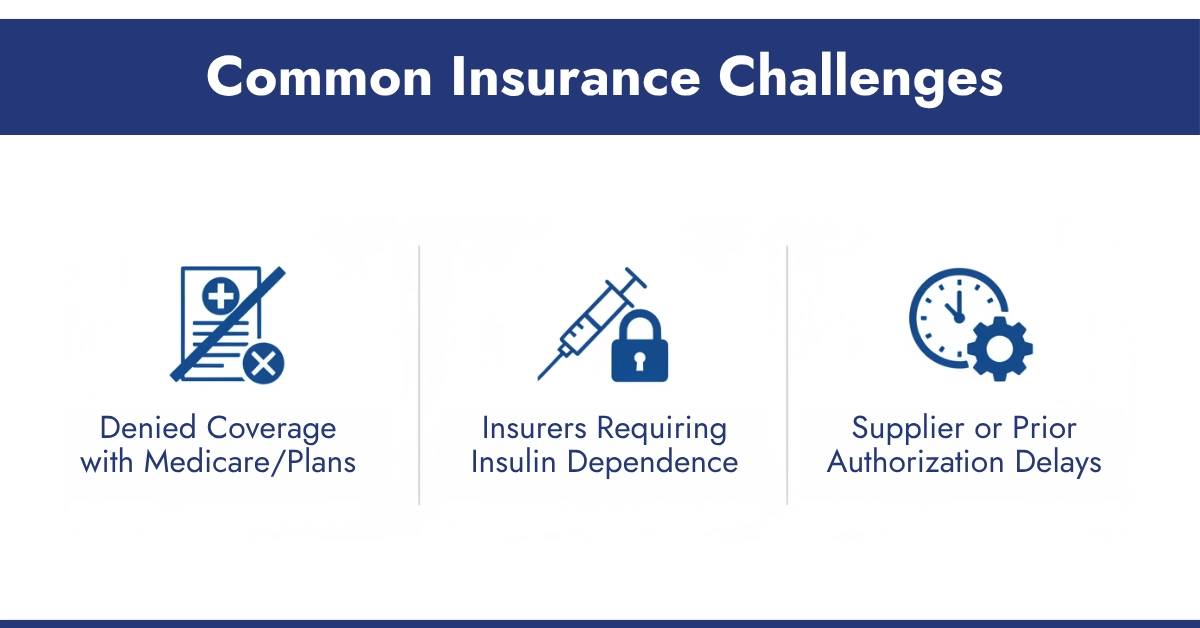
- Denied Coverage with Medicare/Plans: Even when eligible, claims can be denied due to coding errors, lack of documentation, or supplier issues. Double check that the claim uses the correct HCPCS codes and that all documentation is submitted properly.
- Insurers Requiring Insulin Dependence: Some plans incorrectly deny CGM claims for people not on insulin, even though Medicare criteria allow coverage for those with problematic hypoglycemia.
- Supplier or Prior Authorization Delays: Insurance benefits and requirements change frequently. A specialized supplier like CGM Monitors can expedite verification, prior authorization, and delivery so you don’t run out of sensors.
How CGM Monitors Handles Insurance For You
Most competitors tell you to “contact your insurer.” CGM Monitors does it for you — at no extra cost:
- Submit your insurance card, doctor’s info, and chart notes.
- CGM Monitors verifies your eligibility and benefits.
- Prior authorization is initiated on your behalf.
- Your device ships directly to your door.
- Trusted supplier with 94% satisfaction.
- Monthly sensor refills are also scheduled automatically, so you never run out.
Conclusion
Getting a CGM covered by insurance doesn’t have to be a maze. With clear eligibility criteria, proper documentation, and an experienced supplier like CGM Monitors by your side, you can reduce out of pocket costs, avoid delays, and stay on top of your diabetes management.
Ready to check your insurance and start the coverage process? Click through our Check your benefits for free and let our team help you today.
Disclaimer:
This blog is provided strictly for informational purposes and reflects original content written and gathered from multiple reputable sources.
It is not copied from any one source. It does not constitute medical, legal, or insurance advice, nor is it a substitute for professional diagnosis, treatment, or coverage eligibility consultation. Always consult your doctor or benefits specialist before acting. CGM Monitors is a DME supplier; do not rely solely on this article to determine coverage or eligibility. Some visuals are AI generated for illustration only.
Frequently Asked Question
Does insurance cover CGMs for Type 2 diabetes?
Yes. Medicare covers CGMs for Type 2 patients who use insulin or have a history of problematic hypoglycemia. Many private plans also cover Type 2 patients; eligibility varies by plan.
What if my insurance requires prior authorization?
CGM Monitors manages the full prior authorization process for you from gathering your records to submitting the request, so you don’t deal with the back-and-forth.
Can I use my FSA or HSA for a CGM?
Yes. CGMs are eligible expenses under both Flexible Spending Accounts and Health Savings Accounts when purchased with a valid prescription.
Does Medicare cover CGMs used only on a smartphone?
No. Medicare requires a physical DME receiver to qualify for coverage. Using CGM data exclusively on a smartphone does not meet Medicare’s DME definition.
Can private insurance cover CGMs?
Yes, most major private plans cover CGM systems with a prescription and prior authorization.

Write a comment
Your email address will not be published. All fields are required