
Table of content
- How Long Do CGM Sensors Actually Last?
- Brand-by-Brand Sensor Wear Time at a Glance
- What Makes the Dexcom G7 15-day Different from the Standard G7?
- Why Don’t CGM Sensors Last More Than a Few Weeks?
- Why Is Your CGM Sensor Failing Before Its Time?
- How Can You Help Your CGM Sensor Last Its Full Wear Period?
- How Many CGM Sensors Will You Need Each Month?
- When Should You Actually Replace Your CGM Sensor?
- Conclusion:
- Frequently Asked Question
Continuous glucose monitors (CGMs) make diabetes management easier by tracking glucose levels all day without fingersticks. Running out of CGM sensors mid-month is stressful. Watching your sensor die two days early costs you money. And you also don’t know which brand lasts the longest, making every purchase feel like a gamble. But the real-world wear time doesn’t always match the number printed on the box.
Your lifestyle, placement, and device type all play a role.
This guide answers all of that clearly. You’ll know exactly how long each brand’s sensor lasts, why sensors fail early, and how to get every last day out of them.
How Long Do CGM Sensors Actually Last?
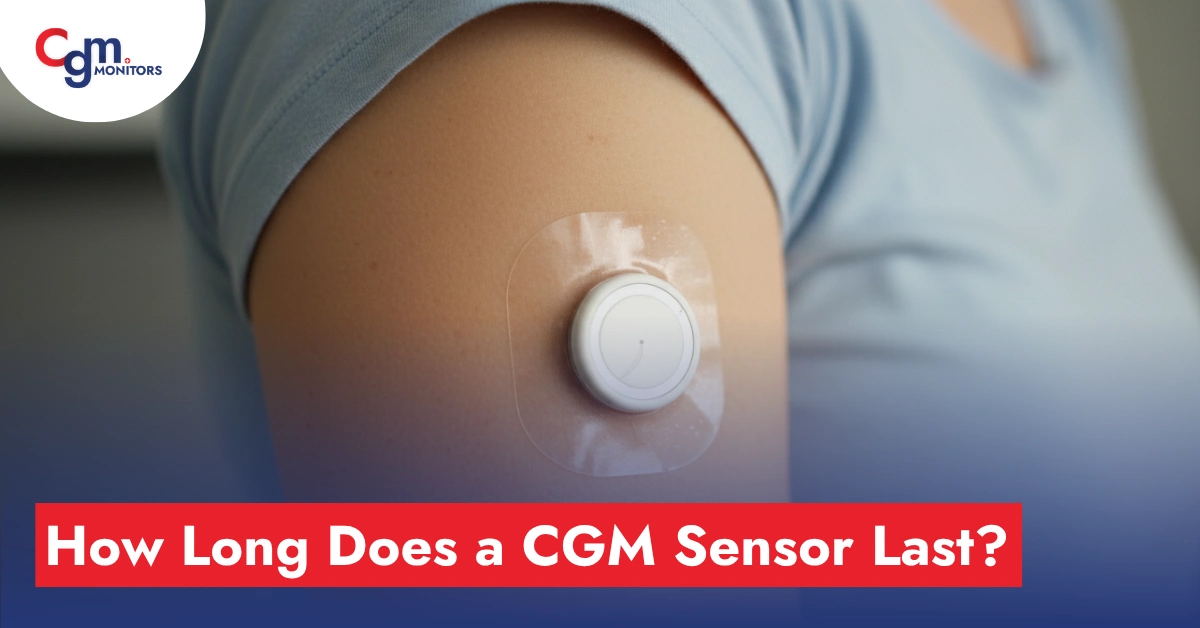
Most CGM sensors last between 7 and 15 days. The exact wear time depends on the brand and model you use. And some implantable CGM are last 6 months or longer.
Brand-by-Brand Sensor Wear Time at a Glance
| Brand | Model | Wear Time | Notes |
| Dexcom | G6 | Up to 10 days | Widely used CGM, transmitter lasts ~3 months. |
| Dexcom | G7 (standard) | 10 days + 12-hr grace period | MARD 8.2%; app alerts. |
| Dexcom | G7 15 Day (NEW) | 15 days + 12-hr grace period | FDA 2025; adults 18+; 74% full wear. |
| Abbott | FreeStyle Libre 2 | Up to 14 days | Scan-based; affordable. |
| Abbott | FreeStyle Libre 2 Plus | Up to 14 days | Extended option. |
| Abbott | FreeStyle Libre 3 | Up to 14 days | Real-time; compact. |
| Abbott | FreeStyle Libre 3 Plus | Up to 15 days | Latest Abbott. |
| Medtronic | Guardian 4 | Up to 7 days | Pump-integrated. |
| Eversense | 365 (implantable) | Up to 365 days | Implantable; in-office insert. |
Each sensor stops transmitting data once its programmed wear period ends. The device alerts you before that happens so you can plan your replacement.
What Makes the Dexcom G7 15-day Different from the Standard G7?
The Dexcom G7 15 Day Sensor is the newest version of the G7. The FDA cleared it in April 2025 for adults aged 18 and older.
Here’s what sets it apart:
- Extended wear: 15 days of continuous reading, plus a 12-hour grace period, giving you 15.5 total days.
- Best-in-class accuracy: It carries a MARD of 8.0%, making it the most accurate wearable CGM available right now.
- Fewer changes: You use 2 sensors per month instead of 3, which reduces waste and saves money over time.
- Same trusted design: Waterproof build, Apple Watch support, caregiver sharing, and automatic activity logging remain intact.
One thing to know:
According to Dexcom, approximately 73.9% of sensors reached the full 15-day period. That means roughly 1 in 4 sensors may not make it through the full wear period. If yours fails early, contact Dexcom support; they offer replacements for sensors that don’t complete their intended wear time.
If you are interested in the New Dexcom G7 15-day sensor and want to see its latest features, read our blog “Advanced Dexcom G7 15-day Sensor with Latest Features.”
Why Don’t CGM Sensors Last More Than a Few Weeks?
This is a question most competitors never answer. Here’s the simple science:
- A tiny filament sits just under your skin and reads glucose from interstitial fluid.
- Over time, enzymes in that fluid break down the sensor’s chemistry, which is called enzymatic degradation.
- Your body also gradually forms a thin tissue layer around the sensor, which blocks accurate readings.
- Once that happens, the sensor loses its ability to deliver reliable data.
This is not a flaw; it’s biology. No current external sensor can safely last longer than 15 days without accuracy dropping.
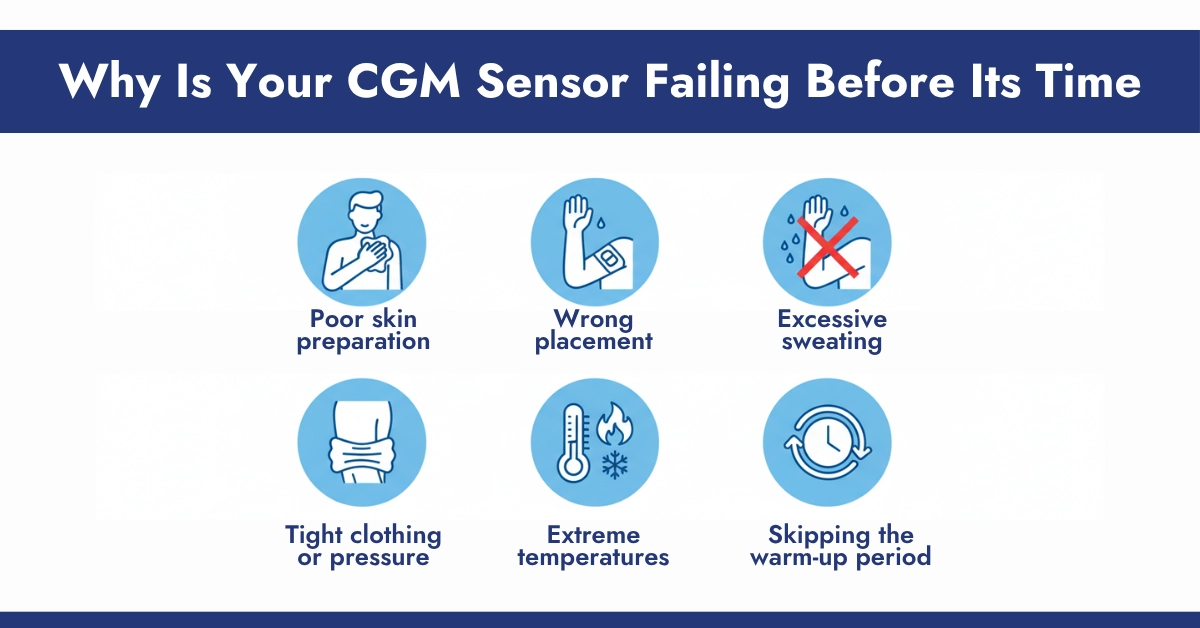
Why Is Your CGM Sensor Failing Before Its Time?
Early sensor failure is one of the most common frustrations. These are the real reasons it happens:
- Poor skin preparation: Oily or damp skin weakens the adhesive from the start.
- Wrong placement: Areas with too much muscle movement (like forearms during exercise) cause readings to become unstable.
- Excessive sweating: Sweat breaks down the adhesive faster than anything.
- Tight clothing or pressure: Sleeping on the sensor repeatedly can dislodge the filament.
- Extreme temperatures: Very hot or cold environments affect both the adhesive and sensor accuracy.
- Skipping the warm-up period: Every new sensor needs a warm-up time (1-2 hours, depending on brand) before it gives reliable readings; skipping this step leads to confusion and unnecessary removal.
How Can You Help Your CGM Sensor Last Its Full Wear Period?
Small habits make a big difference. Here’s what actually works:
- Use alcoholic wipes to clean and dry your skin before inserting.
- Rotate your insertion sites with every new sensor; using the same spot repeatedly causes skin thickening.
- Press the adhesive firmly after application and rub around the edges for 30 seconds.
- Use a CGM adhesive overlay patch; this is the single most effective way to keep a sensor in place.
CGM Monitors offers purpose-built patches for every major brand:
- Dexcom G7 overlay patches.
- FreeStyle Libre 3 patches with cutout.
- FreeStyle Libre 2 patches without cutout.
These patches grip the sensor edge and prevent lifting during workouts, swimming, and sleep, something most competitors mention but never show you how to find.
How Many CGM Sensors Will You Need Each Month?
| Brand | Sensor Wear | Sensors Per Month |
| Dexcom G6 | 10 days | ~3 sensors |
| Dexcom G7 (standard) | 10 days | ~3 sensors |
| Dexcom G7 15 Day | 15 days | ~2 sensors |
| FreeStyle Libre 2/3 | 14 days | ~2 sensors |
| FreeStyle Libre 2/3 Plus | Up15 days | ~2 sensors |
| Medtronic Guardian 4 | Up to 7 days | ~4 sensors |
Running out between orders is a real problem, especially with insurance plans that only ship one month’s supply at a time.
CGM Monitors solves this. With our monthly refill subscription, your next supply ship before your current one runs out, automatically, every 26 days. No reordering, no gaps, no stress. And if you have insurance, our team handles prior authorization and benefit verification for you. Check your eligibility here.
When Should You Actually Replace Your CGM Sensor?
Replace your sensor when:
- Your device sends an end-of-session alert (typically 1-2 days before expiry).
- Readings become erratic or don’t match how you feel.
- The adhesive is visibly lifting from your skin.
- You experience skin irritation or redness under the patch.
- The sensor failed to start during the warm-up period.
If your sensor fails early: Contact Abbott or Dexcom customer support directly; both brands replace defective sensors under warranty. For sensor supply concerns, the CGM Monitors team is also available to help you stay on track.
Conclusion:
CGM sensor wear time ranges from 7 days (Medtronic Guardian 4) to a full year (Eversense 365). For most users, FreeStyle Libre and the new Dexcom G7 15 Day offer the best balance of long wear time and ease of use.
The key to getting every day out of your sensor is simple: Proper skin preparation, smart site selection, and a quality overlay patch.
CGM Monitors supplies genuine sensors from Abbott, Dexcom, and Medtronic with free delivery across the USA, monthly refills, and full insurance support. Explore our CGM devices or check your insurance coverage today.
Disclaimer:
The information in this article is for general knowledge & educational purposes only. It is based on authoritative sources and has been written in our own words to help you understand CGM sensor life. This content is not medical advice. If you plan to start, change, or stop using a medical device, medication, or treatment, consult with a healthcare professional. CGM Monitors is a DME supplier that provides devices to support diabetes management, not clinical advice. Some images in this article are generated by AI for illustration purposes only.
Frequently Asked Question
Can I wear a CGM sensor longer than its recommended wear time?
No. Once the sensor’s programmed wear period ends, it stops transmitting accurate data. Accuracy declines toward the end of the wear period and wearing it past the grace period increases the risk of misleading readings. Always replace on time.
What is the longest-lasting CGM sensor available right now?
The Eversense 365 holds that record. It’s an FDA-cleared implantable sensor that lasts a full year. Unlike standard CGMs, it requires a minor in-office procedure for insertion and removal. It’s ideal for people who want to eliminate frequent sensor changes entirely.
Does the Dexcom G7 15 Day work the same as the standard G7?
Yes, same design, same app, same features. The only difference is the extended 15-day wear time and the improved MARD accuracy of 8.0%. It was FDA-cleared in April 2025 for adults 18 and older.
Why does my CGM sensor keep falling off?
The most common cause is skin preparation. Oily or damp skin prevents the adhesive from bonding properly. Use an alcohol wipe, let it dry completely, then apply the sensor. Adding a CGM overlay patch gives an extra layer of protection, especially for active users.
Does insurance cover CGM sensor replacements?
Most major insurance plans, Medicare, and Medicaid cover CGM sensors when you meet eligibility criteria. CGM Monitors handle the full prior authorization process on your behalf. Fill out a free check to see what your plan covers.


Write a comment
Your email address will not be published. All fields are required