
Table of content
- What Is the Dawn Phenomenon and Why Does It Happen?
- What Is the Somogyi Effect & Is It Still Relevant?
- Dawn Phenomenon vs Somogyi Effect: Side-By-Side Comparison
- The Common Symptoms for Both Conditions That You Must Watch
- How Do You Find Out Which One You Have?
- Treatment Options for Both Conditions That Actually Work
- Other Reasons Your Morning Blood Sugar Could Be High
- Conclusion:
- Frequently Asked Questions
You check your blood sugar first thing in the morning, and it’s high again. You didn’t eat anything overnight. You took your medication. So why is this happening?
This is one of the most frustrating and confusing experiences for people living with diabetes. The answer often comes down to two conditions: the Dawn Phenomenon and the Somogyi Effect. They look the same on the surface, both cause high morning blood glucose, but they have completely different causes, and treating the wrong one can actually make things worse.
This guide will help you understand exactly what each condition is, how to tell them apart, and what you can do today to take control of your mornings.
What Is the Dawn Phenomenon and Why Does It Happen?
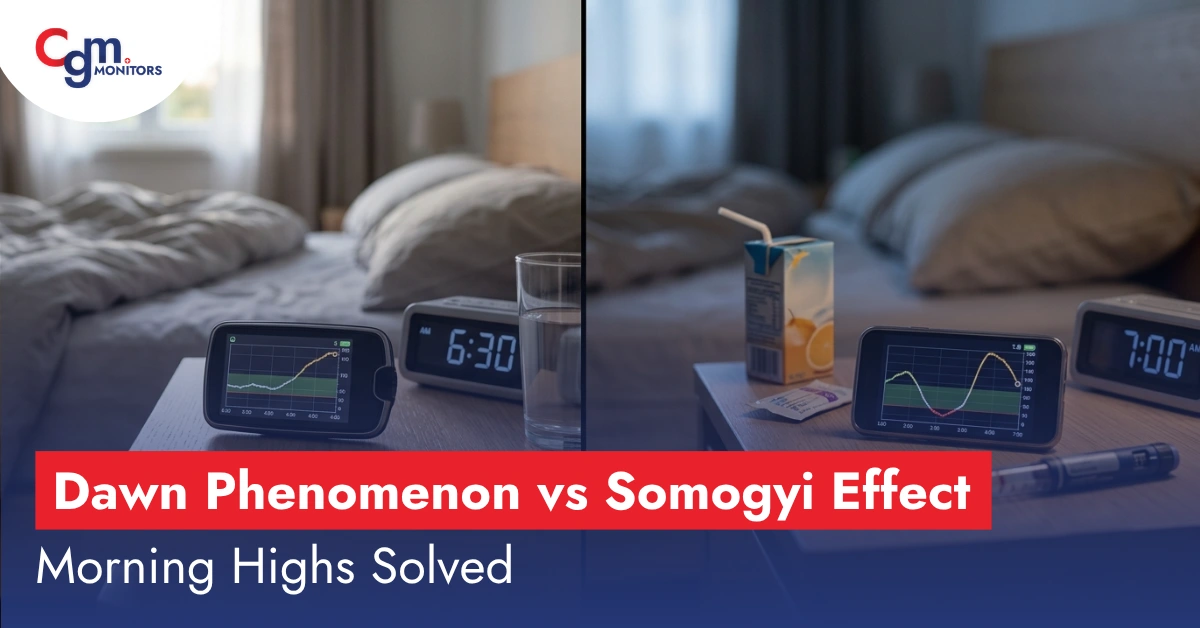
The Dawn Phenomenon is a natural rise in blood sugar that happens in the early morning hours, typically between 3 a.m. and 8 a.m., in people with diabetes.
Every morning, your body prepares itself to wake up. It releases a group of hormones, mainly cortisol, glucagon, and growth hormones, to prepare you for the day. These hormones signal your liver to release more glucose into your bloodstream.
In people without diabetes, the pancreas responds by releasing more insulin to handle this glucose. But if you have Type 1 or Type 2 diabetes, your body can’t produce enough insulin to counter that hormonal surge. The result: blood sugar climbs while you’re still asleep.
Key Facts:
- Very common (affects ~50% of people).
- Happens regularly.
- Not caused by food or mistakes.
What Is the Somogyi Effect & Is It Still Relevant?
The Somogyi Effect, named after Dr. Michael Somogyi, who first described it in the 1930s, works very differently. The theory is your blood sugar drops too low in the middle of the night (usually from too much evening insulin or a missed bedtime snack). Your body panics and overcorrects by flooding your system with stress hormones, causing a rebound spike by morning.
How it is different from the Dawn Phenomenon
- It starts with low glucose, not high.
- You usually don’t notice it happening.
Important insight:
Modern research using Continuous Glucose Monitors (CGMs) has questioned how often the Somogyi Effect truly occurs. Several studies now suggest that most early-morning highs are caused by the Dawn Phenomenon, not rebound hypoglycemia. Some experts even consider the Somogyi Effect quite rare in practice.
That said, overnight low blood sugar followed by morning highs can still happen, especially in people with Type 1 diabetes who use insulin. So it’s still worth ruling out.
Dawn Phenomenon vs Somogyi Effect: Side-By-Side Comparison
Here’s a side-by-side breakdown to see the differences between the two conditions:
| Feature | Dawn Phenomenon | Somogyi Effect |
| Cause | Natural morning hormone release. | Low blood sugar overnight (rebound) |
| Blood sugar at 2-3 a.m. | Normal or slightly elevated | Low (below 70 mg/dL) |
| Who it affects | Type 1 and Type 2 diabetes | Mainly Type 1, insulin users |
| Common | Very common (~50%) | Rare/debated |
| Morning symptoms | High glucose, mild thirst | High glucose + night sweats, nightmares, fatigue |
| Fix | Adjust timing/dose of medication | Reduce evening insulin or add a bedtime snack |
Advice from CGM monitors:
Check your blood sugar at 2-3 a.m. If it’s low, the Somogyi Effect may be at play. If it’s normal or rising, it’s almost certainly the Dawn Phenomenon. Use a CGM device like the Dexcom G7 that gives you real-time glucose readings. You can get it from CGM monitors.
The Common Symptoms for Both Conditions That You Must Watch
Both conditions share similar morning symptoms because they both end up in high blood sugar. These include:
- High fasting glucose reading upon waking.
- Unusual thirst or dry mouth.
- Increased urination in the morning.
- Headache or brain fog in the morning.
- Irritability or low energy.
Warning Signs of Somogyi:
The Somogyi Effect may also produce signs of overnight low blood sugar that you barely notice, including:
- Restless sleep or nightmares.
- Waking up sweaty despite a cool room.
- Feeling confused or exhausted even after a full night’s rest.
- If any of these sound familiar, tracking your overnight glucose levels is essential.
How Do You Find Out Which One You Have?
Knowing the cause requires more than a single morning reading. Here’s how to investigate properly. The 2-3 a.m. Blood Sugar Test: Your doctor may ask you to set an alarm and manually test your blood glucose in the middle of the night for several consecutive nights. What you find guides the answer:
- Blood sugar is low (under 70 mg/dL) → Somogyi Effect is likely.
- Blood sugar is normal or rising → Dawn Phenomenon is the cause.
- Blood sugar is high throughout → Your medication may simply be wearing off before morning.
If you’re serious about solving this problem, a CGM is one of the most powerful tools available. At CGM Monitors, you can explore top-brand CGM devices from Abbott, Dexcom, and Medtronic, with free delivery and insurance coverage options across the USA.
Treatment Options for Both Conditions That Actually Work
Treatment depends on the cause. Dawn Phenomenon needs insulin timing changes, while Somogyi requires preventing overnight lows.
For Dawn Phenomenon:
- Adjust insulin timing (closer to bedtime).
- Avoid late-night carbs.
- Consider insulin pump adjustments.
- Review medication timing with your doctor.
For the Somogyi Effect:
- Reduce evening insulin dose.
- Add a balanced bedtime snack.
- Avoid late intense exercise.
- Monitor overnight glucose closely.
For Type 2 Diabetes:
- Focus on diet timing.
- Improve sleep quality.
- Adjust oral medications.
- Manage insulin resistance.
Treating the wrong condition can worsen your glucose levels, this is why correct diagnosis matters.
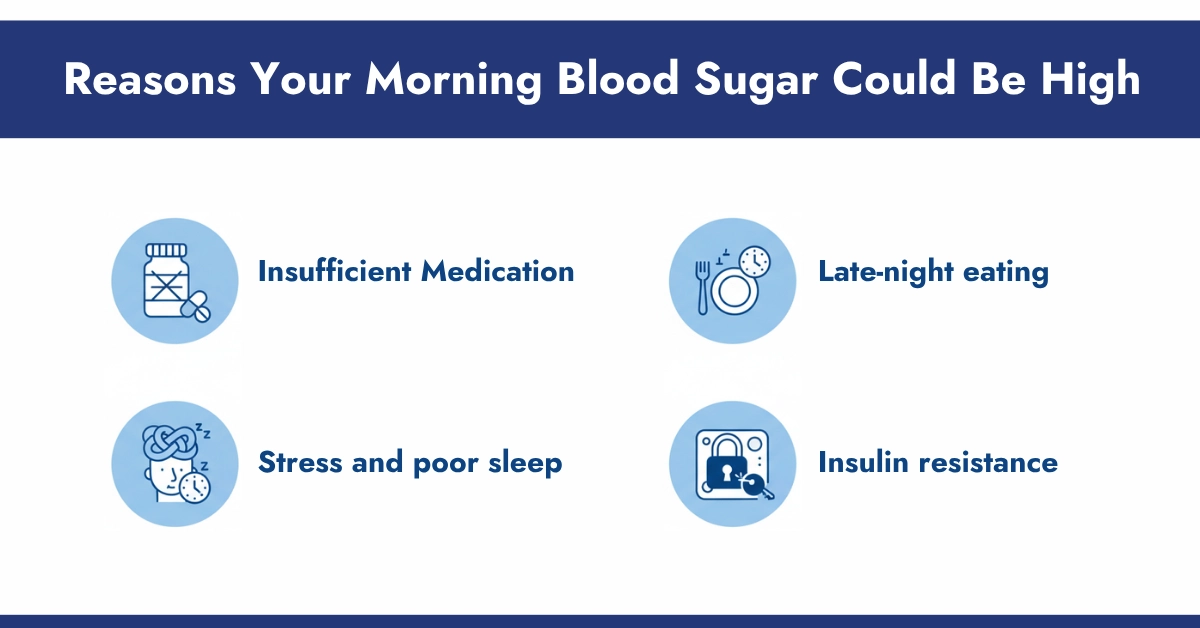
Other Reasons Your Morning Blood Sugar Could Be High
There are other common reasons for fasting hyperglycemia that are worth discussing with your doctor:
- Insufficient medication: Your insulin or oral medication may simply be wearing off before morning.
- Late-night eating: A high-carb meal within 2-3 hours of bedtime can still be raising your levels well into the early morning, even if you feel fine when you go to sleep.
- Stress and poor sleep: Elevated cortisol from poor sleep alone can push glucose higher.
- Insulin resistance: Especially in Type 2 diabetes, morning resistance to insulin is common and often under-addressed.
Understanding the full picture is why CGM data, reviewed alongside your doctor, is so much more powerful than a single morning reading.
Conclusion:
High morning blood sugar is not a random event. It has a cause, and most of the time, that cause can be found and fixed.
The Dawn Phenomenon is the most common culprit, affecting about half of all people with diabetes through a completely natural hormonal process. The Somogyi Effect is rarer than once believed but still worth investigating if overnight lows are suspected. And in many cases, the true reason is something else entirely, from medication timing to late-night carbs to poor sleep.
The clearest path forward is continuous glucose monitoring. When you can see your overnight glucose data, the mystery disappears. At CGM Monitors, trusted brands like Freestyle Libre, Dexcom, and Medtronic are available with insurance support, free delivery, and a monthly refill program built to keep your management consistent. Check your coverage for free at CGM monitors.
Disclaimer:
This blog is written just to educate you. It is not professional medical advice. Blood sugar patterns and diabetes management vary from person to person. Always consult a qualified healthcare provider before making any changes to your treatment, medication, or lifestyle. Visuals in this blog are created from AI tools, and these are not natural or real images.
Frequently Asked Questions
What is the main difference b/w the Dawn Phenomenon and the Somogyi Effect?
The Dawn Phenomenon is caused by natural hormones your body releases every morning to prepare for waking up. The Somogyi Effect is a rebound high triggered by low blood sugar overnight. Checking glucose at 2-3 a.m. (or with a CGM) reveals which one is occurring.
Does the Dawn Phenomenon affect Type 2 diabetes?
Yes. The Dawn Phenomenon affects both Type 1 and Type 2 diabetes. It’s one of the most common reasons for high fasting blood sugar, even in people who manage their diabetes well during the day.
Is the Somogyi Effect scientifically proven?
The Somogyi Effect is based on a well-known theory, but recent studies using CGM have found that it’s much less common than previously thought. Most cases of high morning blood sugar are now attributed to the Dawn Phenomenon or other causes.
Can a CGM help identify the cause of high morning blood sugar?
Yes. A CGM tracks your glucose throughout the night, allowing you and your doctor to see exactly when levels rise or fall. This is the most reliable way to distinguish between the Dawn Phenomenon and the Somogyi Effect without waking up at 2 a.m. to test manually.
What is the fastest way to lower morning fasting blood sugar?
There’s no single fast fix; it depends on the cause. Common strategies include:
- Adjusting insulin timing or dose.
- Avoiding carbs before bed.
- Improving sleep quality.
- Using a CGM to identify patterns.
Always work with your healthcare provider to make medication changes.
Can stress cause high morning blood sugar?
Yes. Poor sleep and high stress raise cortisol levels overnight, which can elevate blood sugar independently of insulin issues. Addressing sleep quality and stress management can be a meaningful part of improving fasting glucose levels.




Write a comment
Your email address will not be published. All fields are required