

Table of content
- What Is a CGM & Why Is It Different from a Glucose Meter?
- What Are the Three Components of a CGM System?
- How Does a CGM Actually Measure Glucose?
- How Accurate Are CGMs in 2026?
- What Happens After You Apply a New Sensor?
- How to Keep Your CGM On and Readings Stable
- Who Can Use a CGM and Does Insurance Cover It?
- Which CGM Should a Beginner Choose in 2026?
- Conclusion:
- Frequently Asked Question
You just got diagnosed with diabetes mellitus, or your doctor mentioned a CGM, and you feel overwhelmed by sensors, apps, and insurance. Maybe you are tired of fingerstick testing several times a day. Maybe you worry about accuracy, skin irritation, or whether a CGM will actually make your life easier.
This is the guide you should have gotten on day one. It gives you a clear explanation of how a CGM works, why it matters, and what no one ever tells you, including 2026 accuracy data, sensor placement tips, and how CGM Monitors can simplify insurance, refills, and support.
A Continuous Glucose Monitor (CGM) has become one of the most important tools in diabetes management because it replaces guesswork with real-time glucose visibility, helping prevent both dangerous lows and long-term highs.
What Is a CGM & Why Is It Different from a Glucose Meter?
A continuous glucose monitor (CGM) is an FDA-approved wearable medical device that measures your blood sugar levels automatically, every 1-5 minutes, 24/7, without a single finger prick.
A traditional blood glucose meter (BGM) gives you one reading at one moment. That’s useful but limited. A CGM gives you a 24/7 real-time glucose trend.
A BGM only catches problems after they happen. A CGM catches them before the trend arrows tell you you’re dropping fast, so you can eat something now instead of passing out in 20 minutes.
For people managing Type 1 diabetes, Type 2 diabetes, or gestational diabetes, this real-time visibility reduces hypoglycemia (dangerous lows), prevents chronic hyperglycemia (high blood sugar), and makes insulin dosing far safer and more precise.
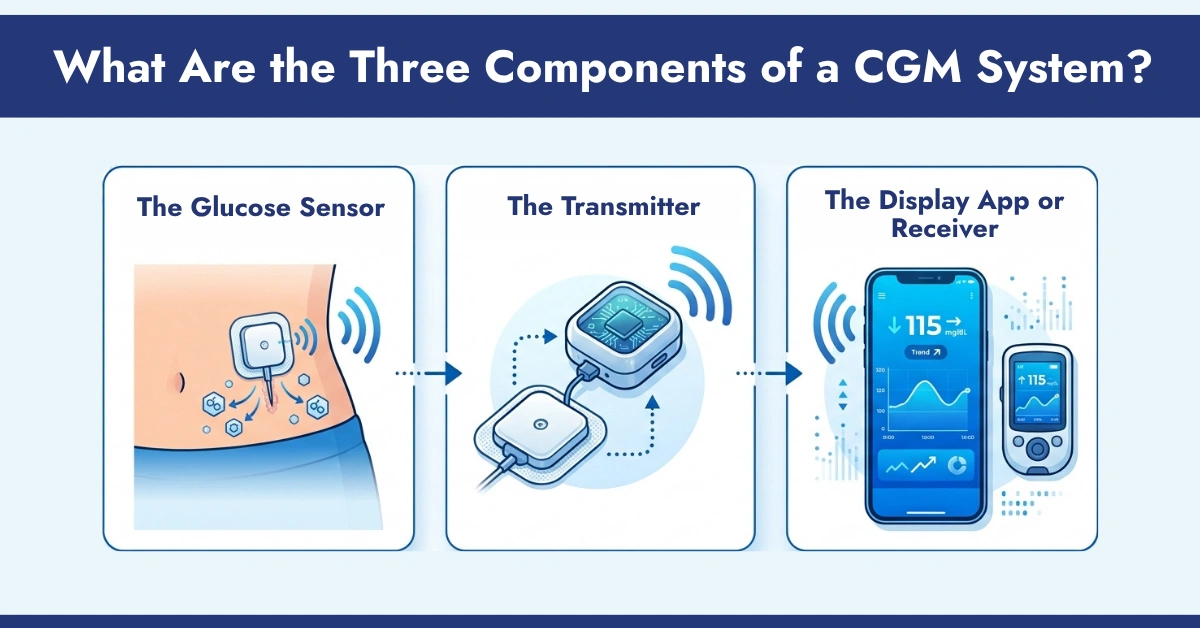
What Are the Three Components of a CGM System?
Every CGM, whether it’s from Abbott, Dexcom, or Medtronic, runs on three parts that work as a single system.
1. The Glucose Sensor:
This is a hair-thin, flexible electrochemical filament, not a needle. That sits in your subcutaneous tissue, roughly 5mm beneath your skin surface. It’s coated with the enzyme glucose oxidase, which reacts specifically with glucose molecules. Most people feel nothing after the first hour.
2. The Transmitter:
The transmitter snaps onto the sensor and handles two jobs:
- It reads the tiny electrical current produced by the enzyme reaction.
- It converts into a mg/dL glucose value.
- It transmits it wirelessly via Bluetooth Low Energy (BLE) to your phone or receiver, every 5 minutes for Dexcom, every 1 minute for FreeStyle Libre 3.
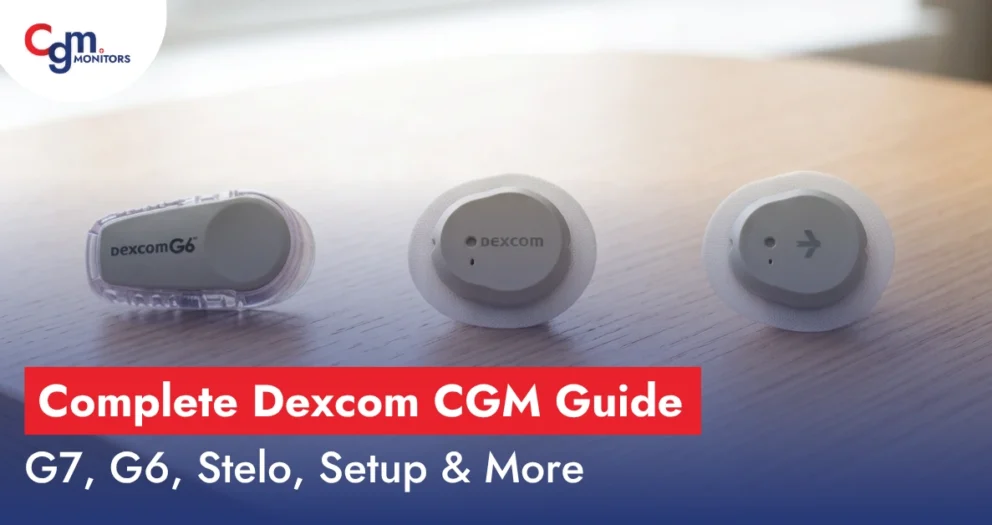
On modern all-in-one devices like the Dexcom G7 and FreeStyle Libre 3 Plus, the sensor and transmitter are a single integrated unit.
3. The Display App or Receiver:
Your smartphone CGM app, like the Dexcom G7 app or LibreLink app, shows your:
- Current glucose number.
- A trend arrow (rising, stable, or falling).
- Customizable alerts for highs and lows.
Most 2026 systems also support remote monitoring:
The Libre LinkUp app lets up to 20 caregivers follow your readings; Dexcom Follow supports up to 10.
Both apps integrate with Apple Health, Samsung Health, and automated insulin delivery systems like Omnipod 5 and Tandem Control-IQ, meaning your CGM data can directly influence how your insulin pump doses.
How Does a CGM Actually Measure Glucose?
Your CGM doesn’t read your blood directly. It measures glucose in interstitial fluid (ISF), the fluid that surrounds cells under the skin. ISF glucose closely mirrors venous blood glucose, but with a natural physiological lag of 5-15 minutes.
The process step by step:
- Glucose in ISF reacts with glucose oxidase on the sensor.
- This reaction produces a small electrical signal.
- The transmitter converts this signal into digital data.
- A built-in algorithm converts it into glucose values.
- The result appears instantly on your phone.
Important For Beginners: Because of that 5-15 minute ISF lag, your CGM reading can look “wrong” during rapid glucose changes. After a large meal or intense exercise, your finger prick and your CGM may show a 20-30 mg/dL difference, and both are correct. They’re measuring the same thing from different biological compartments, slightly offset in time. This is not a device error. It is human physiology.
How Accurate Are CGMs in 2026?
Accuracy in CGM technology is measured by MARD (Mean Absolute Relative Difference). Lower MARD = readings closer to laboratory-reference blood glucose values.
| CGM Device | MARD | Sensor Wear | Warm-Up |
| Dexcom G7 (10-Day) | 8.1% | 10 days | 30 min |
| Dexcom G7 15-Day | ~8.0% | 15 days | 60 min |
| FreeStyle Libre 3 Plus | 8.2% | 15 days | 60 min |
| Medtronic Guardian 4 | ~9.0% | 7 days | 2 hours |
In 2024, PubMed found that FreeStyle Libre 3 sensors were slightly more accurate than Dexcom G7 in MARD and % within ±20 mg/dL thresholds, though both remain clinically excellent for daily use.
In 2026, MARD differences between top devices are clinically negligible for everyday use. The real-world accuracy killer isn’t the sensor; it’s sensor adhesion. A sensor that partially peels or shifts on the skin generates inconsistent filament contact, producing erratic readings regardless of how advanced the device is.
This is precisely why CGM adhesive patches matter. CGM Monitors carries the full range of patches and options with or without cutout, specifically to protect sensor stability and reading reliability across the full wear period.
What Happens After You Apply a New Sensor?
The device shows nothing for an hour, and they think it’s broken, but this isn’t true. Every CGM requires a sensor warm-up period. During this time, the system stabilizes enzyme reactions.
Typically warm-up times:
- Dexcom G7: 30 minutes.
- FreeStyle Libre 3 Plus: 60 minutes.
- Medtronic Guardian 4: up to 2 hours.
Plan sensor changes before bed or early morning. Never change a sensor right before a meal if you depend on the data for insulin dosing. Once warmed up, all current major CGMs are factory calibrated; no fingerstick calibration needed.
How to Keep Your CGM On and Readings Stable
Many users ask: “How do I keep my CGM on during exercise, showers, or while sleeping?”
Here’s what helps:
- Clean the patch area with alcohol and let it dry completely before inserting.
- Avoid lotions or creams near the sensor.
- Use a CGM adhesive patch to secure the sensor.
- Place the sensor on the back of the upper arm. Avoid tight clothing or frequent rubbing over the sensor.
If you ignore a low glucose alert, your glucose may drop into the hypoglycemia range (<54 mg/dL), increasing the risk of confusion, shakiness, or needing someone’s help.
If you ignore a high glucose trend, your body may stay in a high state for hours, contributing to long term damage.
Who Can Use a CGM and Does Insurance Cover It?
CGMs were originally prescribed for insulin-dependent Type 1 diabetes, but the qualifying criteria have expanded significantly.
You may qualify if you have:
- Type 1 or Type 2 diabetes mellitus treated with insulin.
- Recurrent Level 2 hypoglycemia (blood sugar below 54 mg/dL).
- A history of Level 3 hypoglycemia.
- Gestational diabetes requiring close monitoring.
Since 2023, the CMS has expanded CGM coverage under code L33822 to include non-insulin users with documented hypoglycemia history. That’s a major change millions of Type 2 patients don’t know about.
In 2026, Stelo by Dexcom will also be available over the counter, no prescription required, for non-diabetic users tracking metabolic health.
Which CGM Should a Beginner Choose in 2026?
- Dexcom G7: Best for Type 1, fastest warm-up (30 min), strong pump integration, including Omnipod 5 and Tandem. Available through CGM Monitors with insurance billing.
- FreeStyle Libre 3 Plus: Best for Type 2, simplest setup, 15-day wear, fewest alarms.
- Medtronic Guardian 4: Best for Medtronic pump users in a closed-loop automated insulin delivery (AID) system.
Your insurance, lifestyle, and whether you use an insulin pump matter more than any specification comparison.
Conclusion:
A CGM is not just a sensor; it is a continuous feedback system that helps you understand your body in real time. By measuring glucose in interstitial fluid and sending live updates to your phone, it transforms diabetes management from scattered snapshots into a full 24-hour picture.
CGM Monitors is a leading, accredited DME supplier, Exemplary Provider certified, HIPAA compliant, and FDA-approved product sourced, serving 50,000+ diabetes patients across all 50 states. Insurance billing, expert support, and monthly auto-refills, all in one place.
Follow CGM Monitors on Facebook and Instagram for the latest in diabetes management.
Disclaimer:
We explain CGM concepts in a simple, educational way to support your learning journey. For anything related to your health, treatment, or insulin decisions, always follow your doctor’s advice. Images in this blog are generated from AI tools and are real images.
Frequently Asked Question
Does CGM insertion hurt?
It feels like a brief light pinch, under one second. The filament left in place is soft and flexible; most users forget it’s there within an hour.
Why does my CGM read differently from my glucometer?
CGMs measure glucose in interstitial fluid, which lags 5-15 minutes behind blood glucose. Both readings are accurate; they reflect different compartments at slightly different moments in time.
Do I still need fingerstick testing with a CGM?
For most daily management, no. Fingersticks may still be used to confirm an unexpected reading before a treatment decision, per your doctor’s guidance.
How long do sensors last?
Dexcom G7: 10 days. Dexcom G7 15-Day and FreeStyle Libre 3 Plus: 15 days. Medtronic Guardian 4: 7 days.
Does insurance cover CGMs in 2026?
Yes, Medicare, Medicaid, and most commercial plans cover CGMs for qualifying patients. CGM Monitors manages the entire insurance process, including prior authorization.
What is Time in Range (TIR)?
Time in Range is the percentage of time your glucose stays between 70-180 mg/dL. It’s become the gold-standard metric in 2026 for evaluating diabetes control, and CGMs are the only way to accurately track it. A finger-stick meter cannot give you TIR.
Will I bleed when inserting the sensor?
Bleeding is rare but can happen if a small blood vessel is hit during CGM insertion under the skin. It is usually minor and stops quickly without treatment needed.
Can a CGM sensor fall off in the gym/swimming?
Yes, but it is uncommon when properly applied. Sweat, water, friction, and movement are the main reasons CGM adhesives loosen during exercise or swimming.
What if CGM readings scare me too much?
This is normal at the beginning. Focus on glucose trends instead of reacting to every number. Over time, users learn patterns and feel more confident managing diabetes daily.
Does CGM insertion hurt?
Many beginners delay getting a CGM because they’re terrified of the insertion. In reality, most users say a mosquito bite is worse. The fear is almost always bigger than the reality.



Write a comment
Your email address will not be published. All fields are required