
Table of content
- What Causes Type 1 Diabetes and Can It Be Delayed?
- What Are the Early Warning Signs of Type 1 Diabetes?
- How Is Type 1 Diabetes Diagnosed in 2026?
- Why Does Blood Sugar Swing So Unpredictably?
- How Does CGM Tech Improve Daily Life and Safety?
- Which Is Right for You: The Insulin Pump or Injections?
- Does Insurance Cover CGM and Insulin Pump Therapy?
- Conclusion:
- Frequently Asked Questions
Type 1 Diabetes doesn’t follow a predictable script. One day your blood sugar holds steady; the next, a meal you’ve eaten a hundred times sends you hyperglycemia spiking, or a workout drops you into a severe hypoglycemia low you didn’t see coming. That frequent blood sugar fluctuation unpredictability, layered on top of constant fingersticks, dosing decisions, and nighttime low blood sugar worry, is what makes living with this condition so exhausting.
At CGM Monitors, we understand that the real challenge isn’t just the insulin. It is the diabetes burnout and the constant glucose monitoring stress. Here is what actually causes the disease, how it is diagnosed, and how Automated Insulin Delivery (AID) is changing what daily management looks like in 2026.
What Causes Type 1 Diabetes and Can It Be Delayed?
Type 1 Diabetes is an autoimmune condition where the immune system attacks and destroys the insulin-producing beta cells in the pancreas. Without these cells, the body can no longer make insulin, the hormone that moves glucose into cells for energy. Experts at the National Institute of Diabetes and Digestive and Kidney Diseases (NIDDK) believe genetics and environmental triggers, like a virus, play a role.
Key takeaways:
- Not Lifestyle-Based: Unlike type 2, it isn’t caused by diet or weight.
- Immune Therapy: We’ve moved beyond just “replacing insulin.” New immune therapies are now cleared to slow the decline of insulin production in newly diagnosed children.
- Proactive Preservation: Modern medicine focuses on preserving whatever natural pancreas function remains rather than just reactive care.
What Are the Early Warning Signs of Type 1 Diabetes?
Type 1 diabetes symptoms usually appear suddenly.
The most common warning signs include:
- Excessive thirst.
- Frequent urination.
- Unexplained weight loss.
- Blurred vision.
Because these signs can be mistaken for a common illness, many people remain undiagnosed until Diabetic Ketoacidosis (DKA) occurs.
DKA risk is a life-threatening emergency marked by symptoms such as vomiting, fruity-smelling breath, rapid breathing, and confusion. The CDC emphasizes that recognizing these warning signs early is critical, particularly because Type 1 Diabetes in kids can develop quickly and may first be identified during a DKA episode. Type 1 Diabetes can also occur in adults, where it is sometimes initially misdiagnosed as Type 2 Diabetes, potentially delaying proper treatment and increasing the risk of complications.
How Is Type 1 Diabetes Diagnosed in 2026?
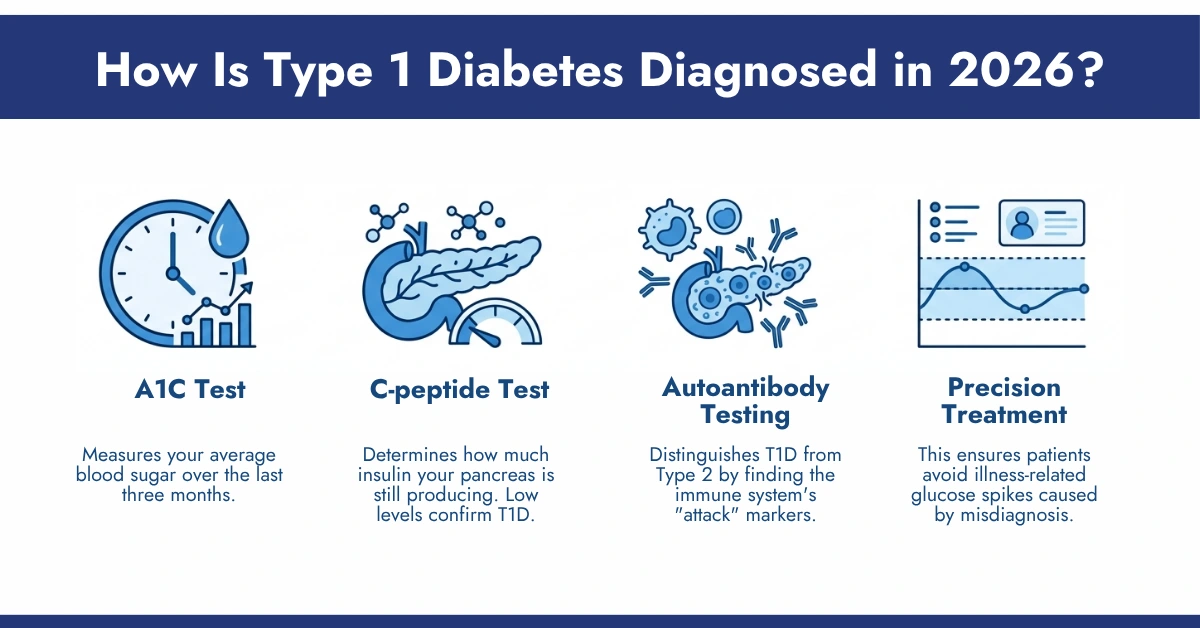
Diagnosis requires precision to ensure the correct insulin therapy is prescribed. Providers no longer rely on a single glucose test; they look for biological markers.
The diagnostic process includes:
- A1C Test: Measures your average blood sugar over the last three months.
- C-peptide Test: Determines how much insulin your pancreas is still producing. Low levels confirm T1D.
- Autoantibody Testing: Distinguishes T1D from Type 2 by finding the immune system’s “attack” markers.
- Precision Treatment: This ensures patients avoid illness-related glucose spikes caused by misdiagnosis.
Why Does Blood Sugar Swing So Unpredictably?
The frequent blood sugar fluctuations in T1D aren’t always caused by what you eat. The “Dawn Phenomenon” causes a hormone surge that raises glucose before you even wake up. Exercise-related glucose drops can happen hours after you finish a workout, while illness-related glucose spikes can occur even if you aren’t eating.
Other factors include:
- Insulin dosing mistakes: Miscalculating carbs for high-fat or high-protein meals.
- Stress & Anxiety: Emotional stress can trigger immediate hyperglycemia.
- Absorption issues: Injecting into the same spot repeatedly creates scar tissue.
This is why real-time glucose monitoring is essential. It identifies these patterns so you can make faster treatment decisions.
How Does CGM Tech Improve Daily Life and Safety?
A Continuous Glucose Monitor (CGM) like the Dexcom G7 or FreeStyle Libre 3 Plus uses a small sensor to track glucose levels every few minutes. Instead of a single “snapshot” from a fingerstick, you get a “movie” of where your sugar is headed.
The benefits of 24/7 insights:
- Time In Range (TIR): The primary goal is now staying between 70-180 mg/dL.
- Hypoglycemia Prevention: Predictive alerts warn you before you go low.
- Reduced Complications: Better control reduces long-term type 1 diabetes complications.
- Remote Monitoring: Parents and caregivers can see a child’s sugar levels from their own phones.
Protect your device and your peace of mind. Save up to 40% on hypoallergenic adhesive over CGM patches designed for active lifestyles.
Which Is Right for You: The Insulin Pump or Injections?
There is no “one size fits all” for insulin therapy. Many still use Multiple Daily Injections (MDI), but Automated Insulin Delivery (AID) or Hybrid Closed-Loop Systems are the gold standard in 2026. These systems, like the Omnipod 5 or Tandem t:slim X2, talk to your CGM and automatically adjust your insulin to prevent both highs and lows.
| Approach | Daily Effort | Glucose Stability | Best For |
| MDI | High (Many injections) | Variable | Simplicity; no worn devices |
| Standard Pump | Moderate (Site changes) | Smoother than MDI | Flexible meal timing |
| AID System | Low (Auto-adjusts) | Highest Time In Range | Preventing nighttime lows |
Unique Insight:
Modern insulin pumps and CGM devices now integrate directly with smartphones and watches, allowing you to manage your health without ever pulling a device out of your pocket.
Does Insurance Cover CGM and Insulin Pump Therapy?
Most people with Type 1 Diabetes qualify for insurance coverage for CGM and pumps because insulin therapy is a primary requirement.
Most Medicare CGM coverage and private insurance plans now cover these devices, but the paperwork can be overwhelming.
At CGM Monitors, we simplify this process:
- Expert Support: We handle the Prior Authorization Assistance and verify your benefits.
- Medicare & Medicaid: We are in-network with major plans like BlueCross BlueShield and Sentara.
- The 26-Day Rule: Most pharmacies wait 30 days to refill, leaving you with a gap. We dispatch your auto-refill every 26 days to ensure you never run out of sensors.
- Direct Pay: If your insurance doesn’t cover a specific device, we offer competitive cash-pay options and nationwide delivery.
Never run out of sensors again. Our easy monthly subscriptions automatically dispatch your refills every 26 days, ensuring your 28-day supply never gets interrupted.
Conclusion:
In 2026, managing Type 1 Diabetes is about working smarter, not harder. Advanced technology like the Dexcom G7 and Omnipod 5 reduces the mental load by automating insulin delivery and predicting glucose trends. This shift improves your Time In Range while eliminating the stress of constant fingersticks.
At CGM Monitors, we bridge the gap between you and this life-changing tech by managing insurance approvals and providing reliable 26-day refills. Reclaim your health today; let technology handle the “diabetes math,” while we handle the paperwork.
Disclaimer:
For more information on the latest research and clinical standards, visit the American Diabetes Association (ADA), the Juvenile Diabetes Research Foundation (JDRF), or the Mayo Clinic. Images in this blog are generated by using AI tools.
Frequently Asked Questions
What is the best CGM for Type 1 Diabetes in 2026?
The “best” depends on your needs. The Dexcom G7 offers a 30-minute warm-up and integrates with most Automated Insulin Delivery systems. The FreeStyle Libre 3 Plus is the smallest sensor and is often the most affordable CGM for those on specific insurance plans.
Can Type 1 Diabetes be managed without finger sticks?
Yes. FDA-cleared continuous glucose monitoring type 1 diabetes systems are accurate enough to make treatment decisions (like dosing insulin) without a finger stick, provided your symptoms match the sensor’s reading.
Does Medicare cover insulin pumps for Type 1?
Yes. Medicare Diabetes Coverage usually covers insulin pump therapy and CGMs under the Durable Medical Equipment (DME) benefit if you meet the criteria of using insulin and seeing your doctor regularly.
How does Type 1 diabetes improve Time In Range?
The most effective way is to use an Automated Insulin Delivery (AID) system. By using a pump that talks to a CGM, the system can correct “highs” and prevent “lows” while you sleep, naturally improving time in range.
What is the difference between Type 1 and Type 2?
T1D is an autoimmune condition where the body makes NO insulin. Type 2 is a condition where the body becomes resistant to insulin or doesn’t make enough. Both require blood sugar management, but T1D always requires insulin therapy for survival.
Will Medicare pay for Type 1 Diabetes CGM and insulin pump?
Yes, if you have a Type 1 Diabetes diagnosis, are treated with insulin, and have had a visit with your doctor in the last six months. CGM Monitors is a Durable Medical Equipment (DME) supplier that handles Medicare Diabetes Coverage claims directly.
Why is my CGM sensor falling off early?
Sensor falling off issues are usually caused by moisture or friction. Using medical-grade adhesive patches (available with or without cutouts) can extend the life of your sensor to the full 10 or 15 days, even during heavy exercise or swimming.


Write a comment
Your email address will not be published. All fields are required