

Table of content
- What Is HbA1c and Why It Matters?
- What Is the Normal HbA1c Range?
- What “Normal” Really Means?
- What Is a Good A1C Target for People with Diabetes?
- Does the HbA1c Normal Range Change by Age?
- Why Is My A1C Still High But My Sugar Looks Normal?
- How Can You Lower Your HbA1c Naturally?
- How Does a CGM Device Help You Manage Your HbA1c Long-Term?
- Conclusion:
- Frequently Asked Questions
Living with diabetes means you’ve probably heard the word “A1C” more times than you can count. But when that lab result lands in your hand, 7.2%, 8.5%, 6.8%, do you actually know what it means for you?
Most people don’t. And that confusion is completely understandable.
You might be eating better, checking your glucose daily, yet still wondering why your HbA1c isn’t where you want it. Or maybe you’ve just been diagnosed and have no idea what a “normal” number even looks like.
This guide gives you a clear breakdown of the HbA1c normal range, what targets make sense at every life stage, and how real-time glucose monitoring helps you finally move that number in the right direction.
What Is HbA1c and Why It Matters?
HbA1c (hemoglobin A1c or glycated hemoglobin) measures the % of red blood cells that have sugar attached to them.
Because red blood cells live for roughly 90 days, this test reflects your average blood sugar over the past 2-3 months.
Why doctors use HbA1c:
- Diagnose diabetes.
- Track treatment progress.
- Predict complications (Kidney damage, neuropathy, & vision loss).
Think of it this way:
- A daily glucose check is like checking the weather today.
- HbA1c is like reviewing the entire season.
What Is the Normal HbA1c Range?
According to the American Diabetes Association (ADA):
| HbA1c Level | Category | Estimated Average Glucose |
| Below 5.7% | Normal | ~117 mg/dL |
| 5.7%-6.4% | Prediabetes | ~126-137 mg/dL |
| 6.5% or above | Diabetes | ~140 mg/dL+ |
| Below 7.0% | Well-managed diabetes (target) | ~154 mg/dL |
What “Normal” Really Means?
A normal A1C below 5.7% means your body is managing blood sugar well on its own. Prediabetes (5.7-6.4%) is not a failure; it’s your early warning system. Research consistently shows that targeted lifestyle changes at this stage can prevent or delay a type 2 diabetes diagnosis entirely.
What Is a Good A1C Target for People with Diabetes?
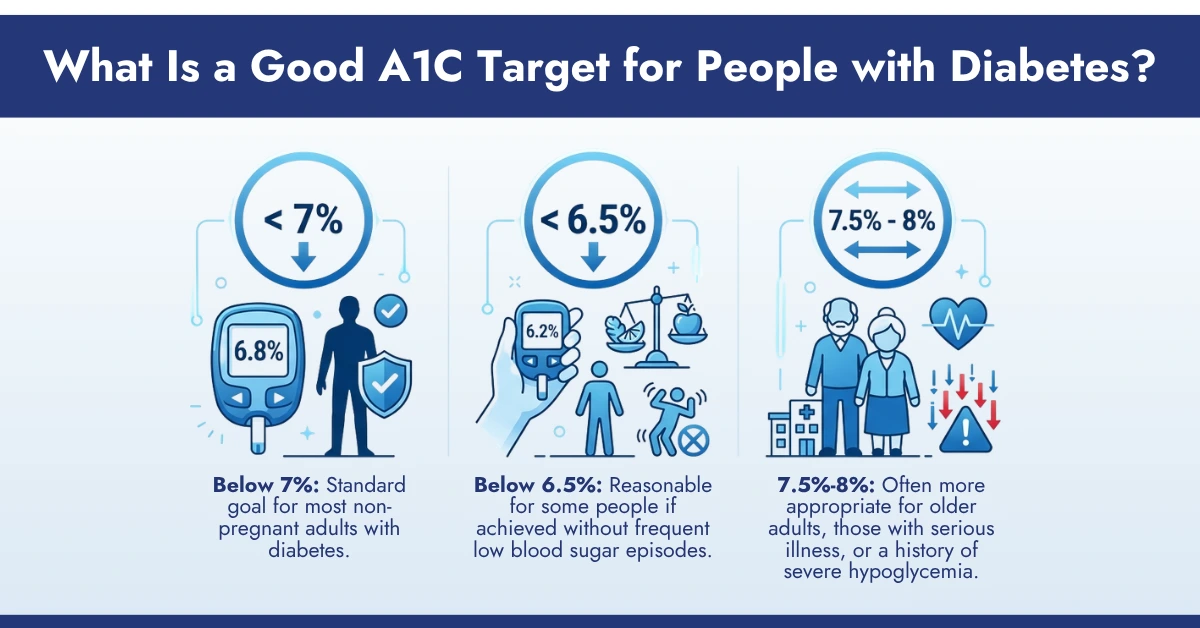
Most adults with diabetes should aim to keep their A1C below 7%, according to the ADA. But “best” depends on your situation.
A1C Targets Based on Your Situation
- Below 7%: Standard goal for most non-pregnant adults with diabetes.
- Below 6.5%: Reasonable for some people if achieved without frequent low blood sugar episodes.
- 7.5%-8%: Often more appropriate for older adults, those with serious illness, or a history of severe hypoglycemia.
The danger of chasing an extremely low A1C without medical guidance is hypoglycemia. Blood sugar is dropping dangerously low. Tight control must always be balanced with safety.
Work with your doctor to set your personal target. Then use the right tools to hit it.
Does the HbA1c Normal Range Change by Age?
Yes, targets become more flexible with age.
Age-based A1C Targets:
- Children and teens (under 18): ADA recommends below 7%, but targets are individualized with a pediatric endocrinologist to reduce hypoglycemia risk.
- Young adults (18-40): Below 7% is the goal, with strong emphasis on preventing long-term complications.
- Middle-aged adults (40-65): Below 7% remains standard unless low blood sugar is a recurring problem.
- Older adults (65+): Targets often relaxed to 7.5%-8.5% to prioritize safety, quality of life, and avoid dangerous lows.
The older you are, the more important it becomes to avoid aggressive treatment that causes sudden drops. Stable blood sugar often matters more than a perfect percentage.
Why Is My A1C Still High But My Sugar Looks Normal?
This is one of the most searched diabetes questions.
Your fingerstick reading shows one moment, but HbA1c reflects 90 days of patterns.
You may miss:
- Post-meal spikes.
- Nighttime glucose rises (dawn phenomenon).
- Stress-related sugar increases.
- Short spikes that normalize quickly.
Example:
- Morning glucose = 95 mg/dL (looks normal).
- After dinner spike = 220 mg/dL (missed).
- Night rise = unnoticed.
HbA1c captures ALL of it.
Common hidden causes:
- Post-meal glucose spike.
- Poor sleep.
- Stress hormones (cortisol).
- Irregular medication timing.
Standard fingerstick testing gives you isolated data points. A Continuous Glucose Monitor (CGM) gives you the full picture, tracking your glucose every few minutes, every hour, all day and night.
Devices like the FreeStyle Libre 3 plus or Dexcom G7 from CGM Monitors show you exactly when your glucose rises, how high it goes, and how long it stays elevated, the three things that most influence your A1C result.
How Can You Lower Your HbA1c Naturally?
Improve daily patterns, not just numbers.
What actually works:
- Eat lower-glycemic foods.
- Walk after meals for 10-20 minutes.
- Take medications consistently.
- Sleep 7-8 hours daily.
- Manage stress actively.
- Track glucose patterns in real time.
CGM Monitors offers Abbott and Dexcom CGM systems with free nationwide delivery, insurance verification, and monthly refill subscriptions, so your supply never runs out when you need it most.
How Does a CGM Device Help You Manage Your HbA1c Long-Term?
A clinic A1C test tells you the result of three months of living. A CGM helps you shape those three months, day by day.
Two Tools, One Goal: Better Blood Sugar Control
| Feature | A1C Test | CGM Device |
| Frequency | Every 3 months | Every 1-5 minutes |
| Shows | 90-day average | Real-time trends |
| Action possible? | After the fact | Immediately |
| Best used for | Confirming progress | Guiding daily decisions |
Check your insurance eligibility today at CGM Monitors. Most plans cover CGM devices, and our team handles the entire process for you.
What Is Time in Range (TIR) & Why It Matters as Much as A1C?
Time in Range (TIR) measures the percentage of time your glucose stays within a healthy target range, typically 70-180 mg/dL. It’s reported by your CGM device and has become one of the most important metrics in diabetes care.
Here’s why it matters:
- A1C gives you an average. But averages can be misleading. A person with frequent highs and lows can have the same A1C as someone with steady, stable glucose.
- TIR shows the full quality of your control, not just the average outcome, but how consistent and stable your blood sugar actually is.
Good TIR Targets:
| Population | TIR Target (70-180 mg/dL) |
| Most adults with type 1 or type 2 diabetes | Above 70% (~17 hours/day) |
| Older adults or high-risk individuals | Above 50% |
| Pregnant women with type 1 diabetes | Above 70% (target range: 63-140 mg/dL) |
Conclusion:
Your HbA1c is one of the most important numbers in your health story, but it’s not the final word. Whether you’re in the normal range and want to stay there, managing a diabetes diagnosis, or trying to understand confusing swings in your levels, the right knowledge and the right tools make everything clearer.
At CGM Monitors, our mission is to give every person managing diabetes access to the best monitoring technology, reliable information, and the support they need to stay in control.
Explore our full range of CGM devices and sensors at CGM Monitors. Follow us on Facebook and Instagram for daily diabetes tips, product updates, and community support.
Disclaimer:
This article is for informational purposes only. Always consult your healthcare provider before making changes to your diabetes management plan. Pictures in this article are created from AI or just for illustrative purposes.
Frequently Asked Questions
Is a 6.8% A1C good for a diabetic?
Yes. A 6.8% A1C is below the ADA’s general 7% target and indicates well-managed blood sugar. For most adults with diabetes, this is a strong, healthy result worth maintaining.
Why is my A1C high if my blood sugar readings seem normal?
Your fasting readings only show one moment in the day. A1C captures every post-meal spike, overnight rise, and stress-related increase over 90 days, events your fingerstick tests likely missed between checks.
What is Time in Range (TIR), and how is it different from A1C?
TIR measures the percentage of time your glucose stays between 70-180 mg/dL. While A1C gives a 3-month average, TIR shows how stable and consistent that control is day to day. A target TIR of above 70% is recommended for most adults with diabetes. Only a CGM device can track TIR automatically.
What is a normal HbA1c level for a non-diabetic person?
A normal HbA1c is below 5.7%. This means blood sugar is well-regulated and diabetes risk is low.
What A1C level is considered dangerous?
An A1C above 9% signals very poor glucose control. It significantly raises the risk of kidney disease, nerve damage, and cardiovascular complications.
Can HbA1c be lowered in just 3 months?
Yes. Since A1C reflects a 3-month average, consistent diet changes, physical activity, and proper medication can produce measurable improvement by your next test.
Is 6.5% A1C considered good for a diabetic?
It sits at the diabetes diagnosis threshold, but can reflect strong control for some individuals. Your personal target depends on age, treatment history, and hypoglycemia risk. Always confirm with your doctor.
What is eAG, and how does it relate to A1C?
eAG (estimated average glucose) converts your A1C into mg/dL so it’s easier to compare with your CGM readings. An A1C of 7% equals approximately 154 mg/dL.
Does using a CGM device affect my A1C result?
No, a CGM doesn’t change A1C. It helps you understand the glucose patterns that determine it, so you can make adjustments that genuinely improve your results over time.
Is 7.5 A1C dangerous?
Not immediately, but it’s above the recommended target. Long-term, it increases the risk of complications if not improved.





Write a comment
Your email address will not be published. All fields are required