
Table of content
- What is a Closed-Loop Insulin System & How Does It Work?
- What Is the Difference Between Hybrid and Fully Closed-Loop System?
- Which Closed-Loop Systems Are FDA-Approved in 2026?
- Which CGM Sensor Is Compatible With Each AID System?
- Who Can Use an Automated Insulin Delivery System?
- Can People With Type 2 Diabetes Use These Systems Too?
- Does Insurance Cover Closed-Loop Insulin Systems in the USA?
- Conclusion:
- Frequently Asked Questions
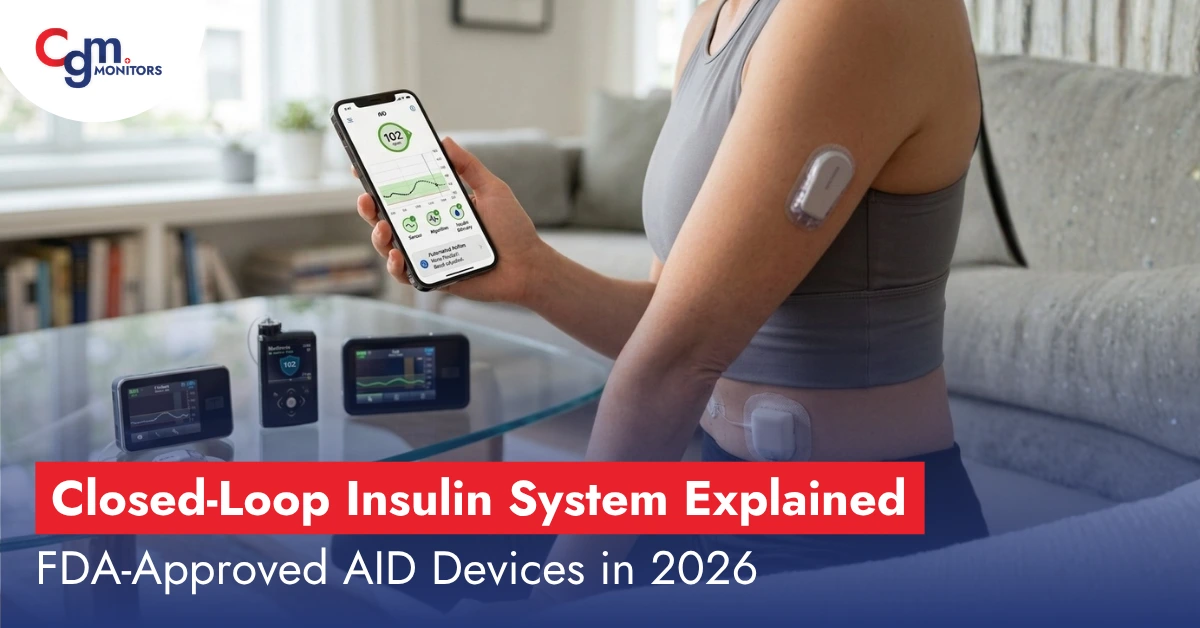
Managing diabetes means constant decisions, checking glucose levels, counting carbs, correcting insulin doses, and lying awake worried about overnight lows. The exhaustion is real. Automated insulin delivery (AID) systems address this directly. They combine a glucose sensor, a smart algorithm, and an insulin pump to automate what your pancreas can’t do anymore.
This guide covers everything, like how these systems work, which are available in 2026, which CGM sensor pairs with which pump, and how insurance covers it all.
What is a Closed-Loop Insulin System & How Does It Work?
A closed-loop insulin system reads your glucose levels continuously and adjusts insulin delivery automatically. It acts as a stand-in for a functioning pancreas, without manual corrections and constant vigilance.
The system earns its name from how it operates. Glucose data flows from the sensor to the algorithm, the algorithm instructs the pump, and the pump delivers insulin. That loop runs every few minutes, around the clock.
Every AID system depends on three parts working in sync:
- Continuous Glucose Monitor (CGM): A small wearable sensor that reads glucose every 1-5 minutes and transmits data in real time.
- The Algorithm: Software built into the pump or a smartphone app that calculates precise insulin needs based on current and predicted glucose trends.
- Insulin Pump: Delivers exact doses automatically based on what the algorithm decides, adjusting every few minutes without user input.
Remove any one component, and the loop breaks. All three must be compatible with the system to function correctly.
What Is the Difference Between Hybrid and Fully Closed-Loop System?
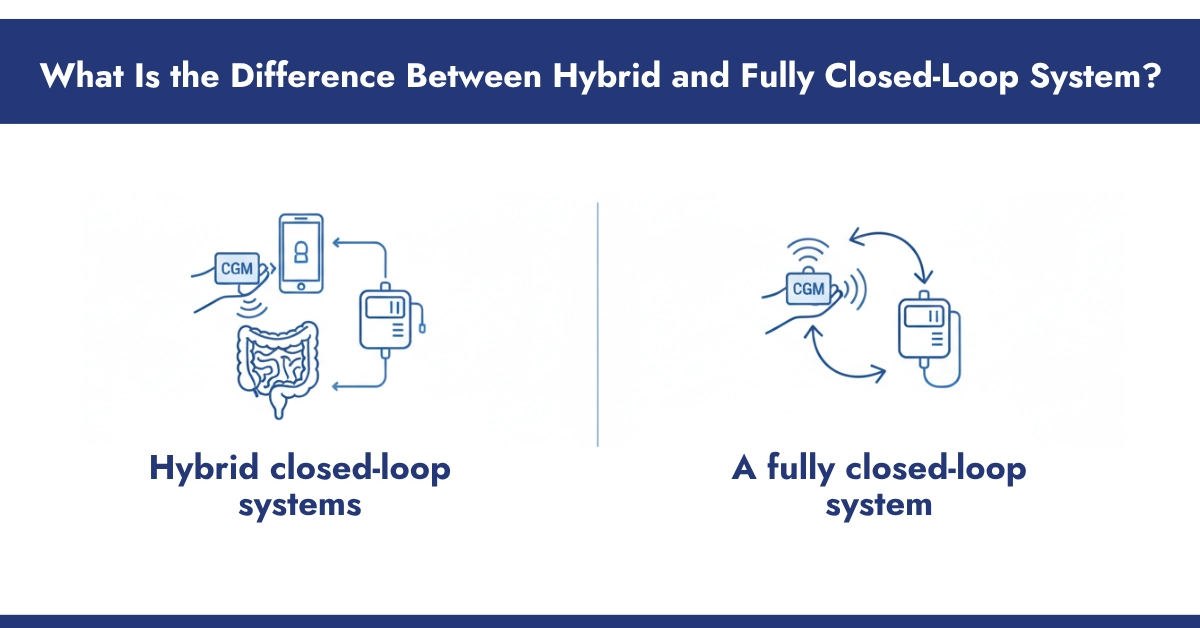
- Hybrid closed-loop systems are what every FDA-approved AID device uses today. They automate background (Basal) insulin delivery continuously. However, you still enter the meal information manually so the system can calculate your mealtime dose. The system handles everything else automatically, including corrections and overnight adjustments.
- A fully closed-loop system aims to eliminate all manual input, including meal announcements. Research is advancing rapidly, but no fully automated commercial system is available in 2026. The closest option currently is the iLet Bionic Pancreas, which simplifies just your body weight; no carb ratio or basal rates required.
When someone refers to an “artificial pancreas,” they almost always mean a hybrid closed-loop system. It’s the most powerful tool available today, but it still requires a small amount of user input.
Which Closed-Loop Systems Are FDA-Approved in 2026?
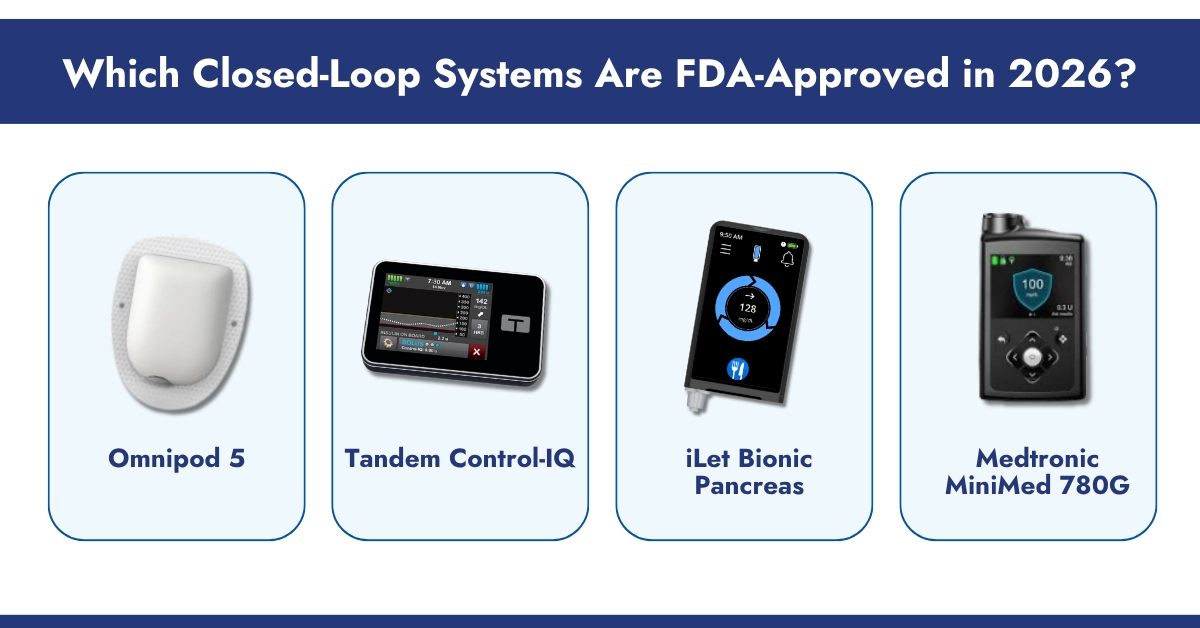
Omnipod 5
Omnipod 5 is the only tubeless AID system available. No tubing, no infusion set. The algorithm, built directly into the Pod, adjusts insulin every 5 minutes and predicts glucose levels up to 60 minutes ahead. It pairs with Dexcom G6, Dexcom G7, and FreeStyle Libre 2 Plus sensors. Available through CGM Monitors.
Tandem Control-IQ
Tandem’s Control-IQ uses the t:slim X2 pump and integrates with Dexcom G6 or G7. It automatically corrects both highs and lows, including during sleep, making it a strong choice for overnight glucose management. Tandem devices are accessible through CGM Devices
iLet Bionic Pancreas
Beta Bionics’ iLet stands apart for its simplicity. Setup requires only your body weight, no carb ratios, no basal programming. Meals are announced simply as small, medium, or large. It works with Dexcom G6 and is available at CGM Monitors.
Medtronic MiniMed 780G
Medtronic’s 780G uses the Guardian Sensor 4 and corrects high glucose automatically every 5 minutes. Its SmartGuard feature provides continuous overnight protection. Medtronic systems are available through CGM Monitors.
Which CGM Sensor Is Compatible With Each AID System?
This is the question most people search for after choosing a pump, and most don’t answer it at all.
| AID System | Compatible CGM Sensor |
| Omnipod 5 | Dexcom G6, Dexcom G7, FreeStyle Libre 2 Plus |
| Tandem Control-IQ | Dexcom G6, Dexcom G7 |
| iLet Bionic Pancreas | Dexcom G6 |
| Medtronic MiniMed 780G | Guardian Sensor 4 |
Compatibility matters before you buy. Choosing an incompatible sensor means your loop won’t close. CGM Monitors stocks all major sensors, including Dexcom systems, FreeStyle Libre series, and Guardian Sensor 4, so you can complete your full AID setup in one place.
Who Can Use an Automated Insulin Delivery System?
Does It Work for Type 1 Diabetes?
Yes, and it was designed here first. AID systems work for children, teenagers, adults, and pregnant women with Type 1 diabetes. The 2026 ADA Standards of Care now designate AID systems as the preferred insulin delivery method for all people with Type 1 diabetes, above both standard pumps and multiple daily injections.
Can People With Type 2 Diabetes Use These Systems Too?
According to the 2026 ADA Standards of Care, AID systems are now also recommended for children, adolescents, and insulin-treated adults with Type 2 diabetes. Clinical data show meaningful improvements in time-in-range for T2D users, without requiring the same level of manual management as traditional insulin therapy.
If you manage Type 2 diabetes with insulin and still struggle with unpredictable glucose levels, an AID system may now be a medically appropriate option. Speak with your provider and ask specifically about AID eligibility.
Does Insurance Cover Closed-Loop Insulin Systems in the USA?
Most commercial insurance plans, Medicare, and Medicaid cover AID systems, but prior authorization is required.
To qualify, you typically need:
- A confirmed diabetes diagnosis.
- Active insulin therapy.
- A valid prescription with chart notes.
- Documented CGM training from your provider.
CGM Monitors manages this entire process for you. Their team verifies your benefits, handles prior authorization, coordinates with your doctor, and delivers your device, usually within 3 to 5 business days. You provide your insurance card and your doctor’s contact information.
They handle the rest.
If your plan doesn’t cover your preferred device, CGM Monitors also accept debit and credit card payments with safe, secure checkout.
Conclusion:
Closed-loop insulin systems represent the most meaningful advancement in diabetes management available today. Whether you have Type 1 or Type 2 diabetes, the right AID device reduces daily burden, stabilizes glucose levels, and gives you back genuine freedom, especially overnight.
CGM Monitors carries all four major FDA-approved AID systems, every compatible CGM sensor, and handles your insurance coverage from start to finish. Explore your options or start a free benefit check today.
Follow CGM Monitors on Facebook and Instagram for the latest updates on diabetes technology and supplies.
Disclaimer:
Content is based on research from multiple trusted sources and written in our own words. It is not intended as medical advice, diagnosis, or treatment. Always consult with a qualified healthcare provider before making decisions about your health or medical devices. CGM Monitors is a DME supplier and provides products, insurance support, and prior authorization assistance; this does not replace professional medical guidance. Some visuals may be created using AI tools for illustration purposes only.
Frequently Asked Questions
Do you still need to count carbs with a hybrid closed-loop system?
Yes. All currently available AID systems require you to enter meal information before eating. The algorithm then calculates and delivers your mealtime dose automatically. Fully automated systems that skip this step entirely are still in development as of 2026.
Which AID system is best in 2026?
There is no universal best option; it depends on your lifestyle.
- Omnipod 5 suits those who want a tubeless, flexible setup.
- Control-IQ and the Medtronic 780G are strong for overnight correction.
- The iLet is ideal for users who want minimal setup complexity.
Your diabetes care team can help match the right system to your needs.
Can the iLet Bionic Pancreas work without carb counting?
Mostly, yes. The iLet only asks you to classify meals as small, medium, or large. It does not require specific carb counts or pre-programmed basal rates. This makes it the simplest commercially available AID system for daily use in 2026.
How do I get an AID system through my insurance?
Contact a DME supplier like CGM Monitors. Provide your insurance details and doctor’s prescription. CGM Monitors verifies eligibility, processes prior authorization, and ships directly to your door, with free delivery across the USA. Fill out the benefit check form to get started.




Write a comment
Your email address will not be published. All fields are required