
Table of content
- Does Medicare Cover CGMs for Type 2 Diabetes?
- What Actually Changed for CGMs in 2026?
- Who Qualifies for Medicare CGM Coverage in 2026?
- No Insulin? You May Still Qualify: Here’s How
- The Bigger 2026 Change Coming for Non-Insulin Type 2 Users
- Which CGMs Does Medicare Actually Cover?
- How to Get Your CGM Covered by Medicare (Step-by-Step)
- Not Covered Yet? Here’s What to Do Right Now
- Conclusion:
- Disclaimer
- Frequently Asked Questions
You have Type 2 diabetes, you don’t take insulin, and you’ve been told Medicare won’t cover your CGM. That’s not entirely true, and millions of people are missing out because of this misunderstanding.
Medicare CGM coverage in 2026 has a path for non-insulin users. A bigger change is also coming that could help nearly 12 million Type 2 patients. This guide tells you exactly where things stand, what you qualify for right now, and what to do if you’ve been denied.
Does Medicare Cover CGMs for Type 2 Diabetes?
Yes, but with conditions most people don’t know about.
Medicare covers CGMs under Part B as DME, paying 80% of the cost after you meet your deductible. You pay the remaining 20%. If you have a Medigap supplement plan, it often covers that 20% too, meaning your CGM could cost you nothing out of pocket.
This is not Part D (prescriptions). It’s Part B, durable medical equipment. That distinction matters when you’re filing a claim or talking to your supplier.
What Medicare Part B Covers
- The CGM device itself.
- Monthly sensors and transmitters.
- A follow-up provider visit every 6 months to keep coverage active.
What Actually Changed for CGMs in 2026?
Several updates in 2026 affect how CGMs are used and managed under Medicare.
- Monthly rental model for CGMs: Beginning in 2026, CMS will pay for all CGMs on a monthly rental basis under the DMEPOS Competitive Bidding Program. This is a major shift. Instead of purchasing a device outright, Medicare now rents it to you monthly. The benefit: you always get current, fully supported technology. The concern the ADA raised: it may disrupt patients already using devices that work for them.
- New remote monitoring codes: The 2026 CMS Physician Fee Schedule includes two new remote patient monitoring codes, one covering 2-15 days of CGM data per month, and another for 10-19 minutes of remote management time. Previously, doctors needed 16+ days of data to bill. Now even partial monitoring counts, meaning your doctor can review your CGM data more flexibly and still get reimbursed.
- Telehealth visits are now permanent: The 2026 rule cements telehealth flexibilities permanently, including virtual supervision and lifted frequency limits for follow-up visits. Your 6-month CGM check-in no longer has to be in person. A video call with your doctor counts.
Who Qualifies for Medicare CGM Coverage in 2026?
Here is the full eligibility checklist:
| Requirement | What It Means for You |
| Diabetes diagnosis | Type 1 or Type 2, both qualify |
| Insulin use or hypoglycemia history | You need at least one of these |
| Provider visit within 6 months | Can be in-person or telehealth |
| Training confirmation | The doctor documents that you know how to use the device |
| FDA-approved CGM | The device must be on Medicare’s approved list |
Medicare now allows people to receive a CGM if they are treated with insulin, any type and any amount. It also allows coverage for individuals who do not take insulin but have a history of problematic hypoglycemia. The six-month provider visit can now be done via telehealth.
No Insulin? You May Still Qualify: Here’s How
If you don’t take insulin, Medicare still covers your CGM if you have a documented history of problematic hypoglycemia. Many people on sulfonylureas, or even GLP-1 medications, experience dangerous blood sugar drops. Those episodes are your key to coverage.
What “Problematic Hypoglycemia” Means
Coverage is available for non-insulin users who have had two or more episodes of level 2 hypoglycemia (blood sugar below 54 mg/dL), or one episode of level 3 hypoglycemia, a severe event where you needed someone else’s help.
What most people don’t know: These episodes don’t need to be recent lab readings. If you’ve ever felt shaky, confused, or passed out from low blood sugar, even years ago, and a doctor documented it, that history counts.
Talk to your doctor at your next visit. Ask them to review your chart for any documented low blood sugar events. That conversation alone may unlock your Medicare coverage today.
The Bigger 2026 Change Coming for Non-Insulin Type 2 Users
CMS is expected to propose a broader coverage expansion in 2026, specifically for Type 2 non-insulin users. Dexcom’s CEO has stated this change could allow nearly 12 million people to access CGMs who currently cannot get Medicare coverage.
The American Diabetes Association updated its clinical guidelines to recommend that clinicians consider CGMs for Type 2 patients taking glucose-lowering medications other than insulin, and private insurers have already started moving toward coverage for this group.
Medicare is the last major payer to catch up. But it is moving.
What you should do right now:
- Ask your doctor to document A1C trends.
- Record medication history.
- Track glucose fluctuations.
- Keep evidence of any low blood sugar events.
Good documentation improves future approval chances.
Which CGMs Does Medicare Actually Cover?
Not every device qualifies. Medicare requires the CGM to be FDA-approved and function as a standalone medical device, not just a smartphone app without a receiver.
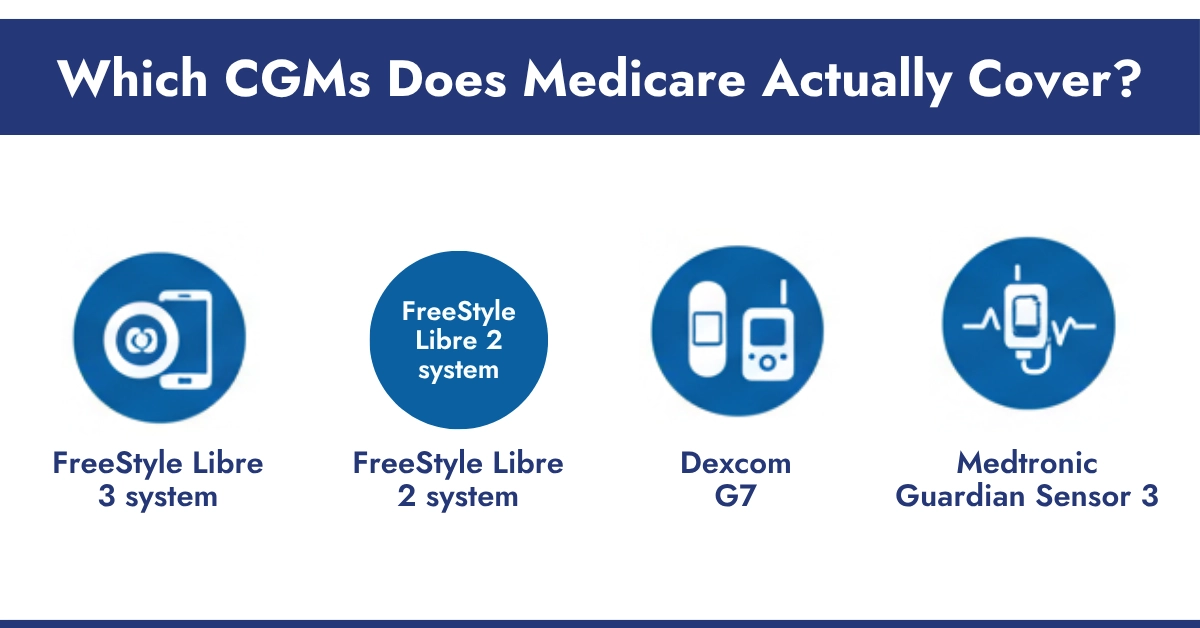
Currently covered under Medicare Part B:
- FreeStyle Libre 2 system: 14-day wear, scan-to-check, trusted by millions.
- FreeStyle Libre 3 system: real-time readings sent automatically to your phone, no scanning needed.
- Dexcom G7: 10-day wear, real-time alerts, one of the most accurate CGMs available.
- Medtronic Guardian Sensor 3: Typically paired with insulin pumps.
At CGM Monitors, we carry all Medicare-covered devices, including the FreeStyle Libre 3 system and Dexcom G7. We handle prior authorization, benefits verification, and insurance billing. You don’t need to figure any of that out yourself.
How to Get Your CGM Covered by Medicare (Step-by-Step)
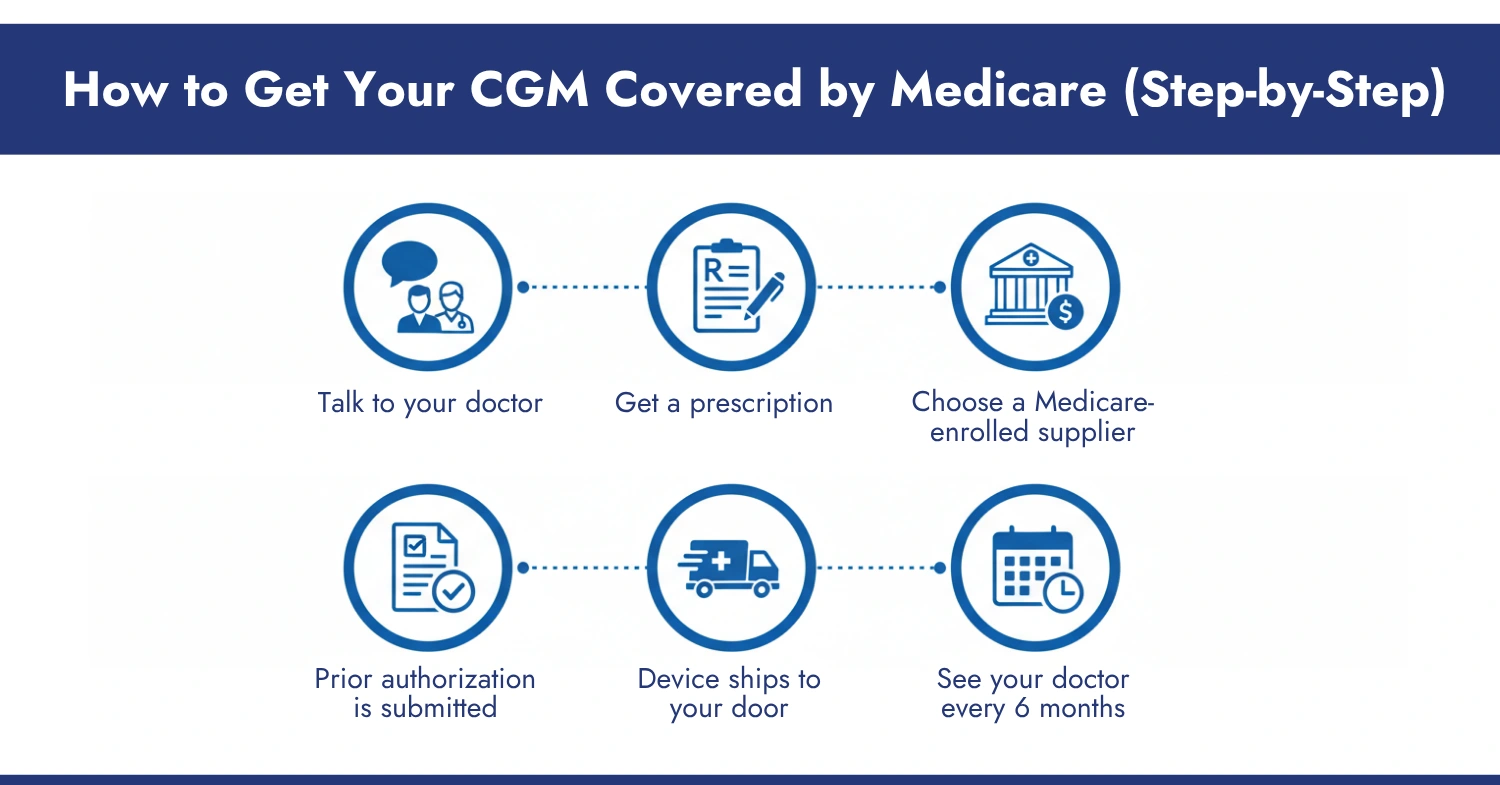
- Talk to your doctor: At your next visit, specifically ask about CGM coverage. Mention any past low blood sugar episodes. Ask your doctor to document medical necessity in your chart.
- Get a prescription: Your doctor writes a CGM prescription with clinical notes that confirm your training and medical need. This paperwork is everything.
- Choose a Medicare-enrolled supplier: Medicare will not pay for CGM supplies from a pharmacy or supplier that is not enrolled in Medicare; you would have to pay the entire bill yourself. Always confirm your supplier is Medicare-enrolled before ordering.
- Prior authorization is submitted: Your supplier handles this. CGM Monitors submits all documentation, verifies your benefits, and confirms coverage before shipping anything.
- Device ships to your door: Once approved, your CGM arrives within 2-3 days. Sensors are refilled automatically monthly, so you never run out.
- See your doctor every 6 months: This telehealth-eligible visit keeps your coverage active. Miss it, and Medicare can stop covering your supplies.
Not Covered Yet? Here’s What to Do Right Now
A denied claim or missing eligibility does not mean you have no options.
If Medicare denied your CGM, your supplier can help you appeal. Documentation errors account for the majority of improper payment denials for glucose monitors; most denials are not clinical rejections, but they are paperwork problems. Getting the documentation right fixes most denials.
If you don’t qualify yet:
- Check your private or supplemental insurance.
- Use direct pay (no insurance required).
- Consider subscription savings for ongoing supplies.
For everything Medicare, Medicaid, and private plans cover in one place, read our full CGM Insurance Coverage Guide 2026: Medicare, Medicaid & Private Plans. It saves you hours of research.
Conclusion:
Medicare CGM coverage in 2026 is still strict, but it is not limited to insulin users only. Patients with Type 2 diabetes may qualify if they have documented hypoglycemia or meet medical necessity criteria.
The system is also improving with:
- More flexible monitoring rules.
- Telehealth acceptance.
- Ongoing supply-based coverage.
The key to approval is simple: proper documentation and a correct application process.
Have questions about your specific coverage? CGM Monitors’ insurance team handles everything, from eligibility checks to delivery. Follow us on Facebook and Instagram for the latest updates on CGM coverage and diabetes management.
Disclaimer
This article is for informational purposes only & doesn’t replace professional medical advice. Medicare coverage rules may change, and eligibility decisions depend on individual medical history and documentation. Always consult your healthcare provider or Medicare-enrolled supplier for personalized guidance. Pictures in this article are generated from AI tools.
Frequently Asked Questions
Does Medicare cover CGMs for Type 2 without insulin in 2026?
Yes, if you have a documented history of problematic hypoglycemia (two severe lows or one episode needing outside help). A broader coverage expansion for all non-insulin Type 2 users is also expected from CMS in 2026.
Which part of Medicare covers a CGM?
Medicare Part B covers CGMs as DME (durable medical equipment). It pays 80% after your deductible. Part D does not cover CGMs.
Can I get a CGM on Medicare if I take metformin or Ozempic?
Not automatically. Unless you also have a history of hypoglycemia, current Medicare rules still require insulin use or documented low blood sugar episodes. This is expected to change with the 2026 CMS decision.
How much does a CGM cost with Medicare?
With Part B, you typically pay 20% of the Medicare-approved amount after you meet your yearly deductible, which is $283 in 2026. A Medigap plan can cover that 20%.
Does my doctor visit have to be in person?
No. The six-month provider visit required to maintain CGM coverage can now be done via telehealth.
What if I can't afford a CGM while waiting for coverage?
CGM Monitors offers direct-pay pricing and monthly subscriptions with up to 40% off.



Write a comment
Your email address will not be published. All fields are required